Every serious account of alpine tourism starts in the same place. It starts on the summit of Mont Blanc on the eighth of August, 1786, with Jacques Balmat and Michel Paccard standing on the highest ground in the Alps for the first recorded time in history. Before that afternoon, the mountains were an obstacle — a thing weather came out of, and mules were killed on. After it, the mountains were a destination. The Chamonix valley, at the foot of the peak, becomes the origin address of an idea that would spread across the Alps, into the Dolomites, over to the Caucasus, and eventually up Everest.
There is a neat symmetry to this story. Horace-Bénédict de Saussure, the Genevan naturalist, had offered a reward for the first ascent decades earlier and climbed the mountain himself the following summer. Chamonix's Compagnie des Guides — the oldest mountain guides' association in the world — was founded in 1821, a direct institutional descendant of the guiding trade that grew up around the ascent. A century later, in 1924, the town hosted what would retroactively be named the first Winter Olympics. It is difficult to design a cleaner origin narrative if you were writing it from scratch.
Because it is a clean story, it has become the only story. Every guidebook, every alpine museum wall panel, every history-of-mountaineering documentary walks the same route: Saussure, Balmat, Paccard, the summit, the guides, the Olympics, the modern town. Chamonix, they all say, is where alpine tourism was born. And they are not wrong, exactly.
Why This Is Actually True
The 1786 ascent genuinely did change what a mountain was for. Before it, the European educated class had a category for high peaks and it was closer to *terror* than *view*. The Alps were a passage between Italy and the north, a thing to survive, a place that appeared in travelogues as an ordeal rather than as a subject. Saussure's own scientific interest in the mountain — barometers, geology, glaciology — was already unusual for its time. The moment Balmat and Paccard reached the top, the summit acquired an author, and the mountain acquired a plot.
Everything institutional about modern alpine tourism does descend from the decades that followed. The Chamonix guides, working first as porters and hunters and then as a formally chartered corps, invented the professional relationship between a paying visitor and a technical mountain. The Alpine Club in London, formed in 1857, took Chamonix's model as a template. The hotel infrastructure of the town — hôtels particuliers giving way to the great fin-de-siècle establishments — followed the reputation the summit had made. When the Belle Époque poster artists working for the Paris-Lyon-Méditerranée railway sat down to sell the Alps as a destination in the 1920s and 1930s, the shape they were selling had been drawn by that first ascent.
And the 1924 Games are not a footnote. They ratified something that had been true informally for a hundred years: Chamonix was the place where an ordinary European city dweller went to be, briefly, in the presence of Europe's tallest mountain. The Games were possible because the infrastructure — trains, hotels, guides, a shared visual imagination — was already there. Read that way, the ascent and the Games are the opening and closing brackets of a single argument. Alpine tourism is a Chamonix invention, and the invention is the summit.
We concede this fully. It is not a bad story. It is only an incomplete one.
But the origin of alpine tourism is not on top of the mountain. It is at the foot of it, forty-five years earlier, in the presence of a glacier that nobody climbed.
Where It Breaks Down
In 1741, two English gentlemen named William Windham and Richard Pococke walked up the Arve valley from Geneva and arrived in Chamonix. They did not climb Mont Blanc. They did not attempt any summit. They walked to the base of the Mer de Glace — the great glacier that flows down the eastern flank of the massif — and they *looked at it*. Then they went home and wrote about it. Windham's account, published shortly after, described the glacier as a frozen sea, an ocean stopped mid-storm. It was the first widely read description of the Chamonix ice in a European language, and it did something the 1786 ascent would never do on its own. It taught readers how to look.
This is the piece the standard origin story skips. Windham and Pococke's visit predates the ascent by forty-five years. Their travelogue circulated among the same educated European audience — the same class that would later fund Saussure's prize — and it framed the Chamonix valley as a subject for the *eye*, not a target for the boot. What they inaugurated in 1741 was the tourist's gaze on a high mountain landscape: the practice of travelling somewhere in order to see it. The 1786 ascent inaugurated something else — the practice of travelling somewhere in order to overcome it. These are different inventions, and they matter to different people.
The Arve valley itself makes the point. Chamonix sits along the river, running roughly northeast, with the Mont Blanc massif walling the southeast and the Aiguilles Rouges walling the northwest. You do not need to climb anything to grasp the composition. The valley is a section drawing — floor, wall, wall, sky — and every image of Chamonix worth having, from the earliest engravings after Windham to the railway posters of the twentieth century, uses that same section. The picture predates the ascent. The picture is the invention.
What the summit-origin story mistakes is the confusion of a heroic act with an aesthetic one. Alpine mountaineering was born in 1786. Alpine *tourism* — the mass practice of travelling to look at high country — was born in 1741 and has been repeating Windham's frame ever since. The trains that filled Chamonix in the Belle Époque were not full of climbers. They were full of people who wanted to see the Mer de Glace from the terrace at Montenvers.
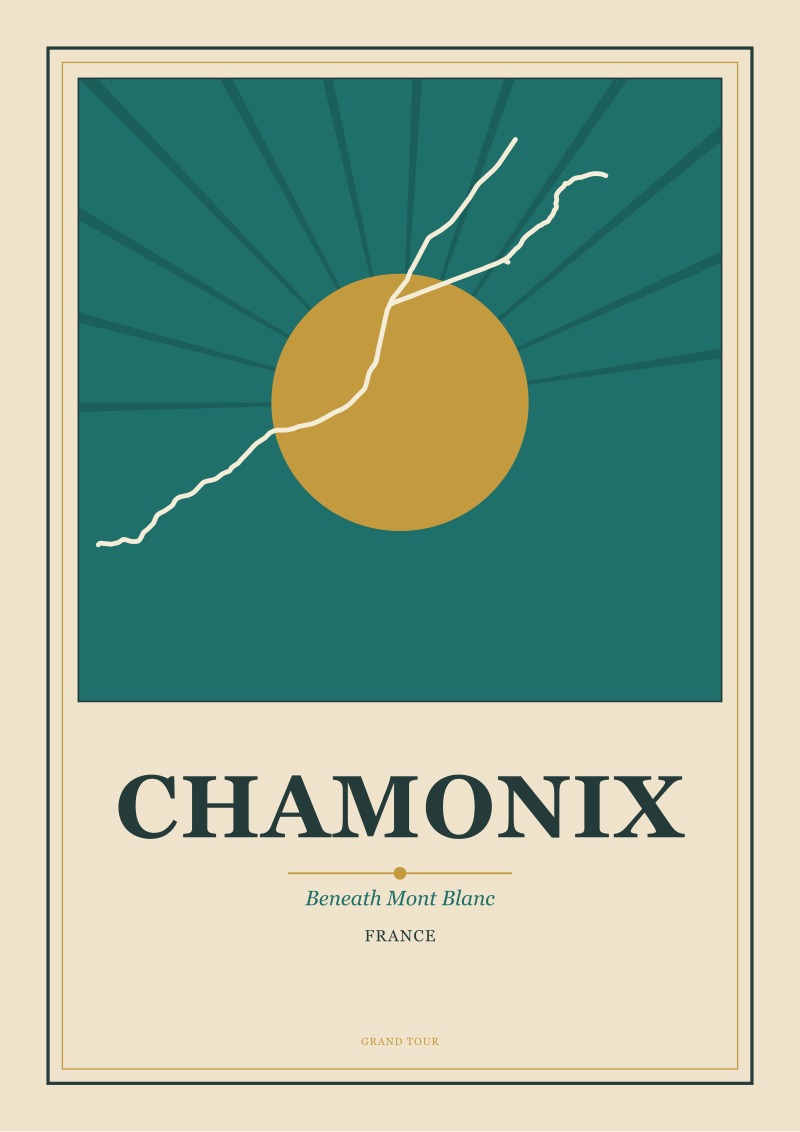 Chamonix
The print from this article · from €29.95
View the print →
Chamonix
The print from this article · from €29.95
View the print →
The Rule I Use Instead
The rule we use, when we sit down to draw Chamonix, is this: the subject of an alpine town is the view from the valley floor, not the view from the summit. This is not aesthetic preference. It is what the historical record actually says about how the place became a destination.
The railway posters make the case cleanly. When the PLM commissioned Alpine posters in the 1920s and 1930s — the golden decade of European travel graphics — the compositions they printed were not summit shots. They were valley shots. Chamonix rendered from below, the town in the middle ground, the peaks along the top edge, the sky doing the heaviest lifting. That was the sellable image because it was the readable image. A viewer standing at a railway kiosk in Paris did not need to be a climber to understand what the poster was offering. It was offering Windham's frame, not Balmat's.
The same rule holds for what people actually do when they arrive. The Mer de Glace is a viewing experience — the funicular to Montenvers has been in operation, in various forms, since the late nineteenth century, and its whole purpose is to deliver the visitor to the same vantage point Windham described. The Aiguille du Midi cable car, which opened in 1955, is not a mountaineering route. It is a delivery mechanism for a view. Even the summits that visitors do reach — via téléphérique — reach them as *observation platforms*, not as climbs.
This is why we draw the valley. The Chamonix of the studio's print — the Arve threading the valley floor, the massif in the middle distance, the river doing the work the ice did in Windham's account — is not an aesthetic decision at odds with the town's history. It is that history's actual composition. If you want to see the origin of alpine tourism, look at what visitors have been looking at since 1741. It has not really changed. There is a Chamonix poster in the studio's shop that treats the valley this way, and it is the correct frame for the same reason Windham's was.
When the Old Rule Still Wins
We are not arguing that the summit-origin story is wrong for every purpose. For the history of mountaineering — the discipline, the ethics, the guiding profession, the alpine clubs, the whole apparatus of ropes and ice axes and Everest — 1786 is the correct starting point. The 1786 ascent is where a specific technical culture begins, and that culture has produced its own extraordinary literature, its own casualties, its own moral weight. If you are writing about how humans learned to climb high, you begin at the summit and you are right to.
The distinction we insist on is only that mountaineering history and alpine tourism history are not the same history. They overlap in Chamonix, which is why they get confused. But the tourist's Chamonix — the one that fills the hotels, the one the trains were built for, the one the posters sold, the one visitors return to without ever intending to climb anything — begins with a different act, thirty-five years earlier, and its subject was never the peak.
 Paris
The print from this article · from €29.95
View the print →
Paris
The print from this article · from €29.95
View the print →
FAQ
When did modern alpine tourism actually begin?
The dominant story dates it to 1786 and the first ascent of Mont Blanc. A closer reading of the sources pushes the date back to 1741, when William Windham and Richard Pococke visited the Mer de Glace and published a widely read account of it. Their visit inaugurated the practice of travelling to the high Alps to *see* the landscape, which is distinct from the practice of climbing it. Both threads run through Chamonix, but they are not the same thread.
Who were Windham and Pococke, and why do they matter?
Two English gentlemen who walked up the Arve valley from Geneva in the summer of 1741 and stood at the base of the Mer de Glace. Neither climbed anything. Windham's published account described the glacier as a frozen sea, and that image circulated through educated European society for the rest of the century. They matter because they are the first widely read authors of the alpine tourist's gaze — the frame every subsequent visitor, poster, and postcard has repeated.
Why is the 1786 Mont Blanc ascent still treated as year zero?
Because it is a cleaner story. A named date, two named climbers, a single summit, an institutional descendant in the Compagnie des Guides. Origin narratives prefer heroism to observation, and the ascent supplies the heroism. Windham and Pococke's 1741 visit is harder to dramatise — nothing conquered, nothing broken, only a description written down — so it gets edited out of the museum panels. That editing is what makes the story feel complete when it is not.
What role did the railway posters play in shaping Chamonix's image?
An enormous one, though not the one usually credited. The Paris-Lyon-Méditerranée and other lines commissioned Alpine posters through the 1920s and 1930s to sell the region as a rail destination. Almost without exception, those posters used the valley view, not the summit view — the town in the middle ground, the massif behind, the Arve or the pastures in the foreground. Millions of European travellers formed their idea of Chamonix from that composition. The tourist image was set by the poster, not by the peak.
Did the 1924 Winter Olympics change what Chamonix meant?
It confirmed rather than changed it. Chamonix was awarded the Games because it already had the infrastructure — rail access, hotels, a mature guiding culture, an internationally legible reputation. What the Games added was official sanction and a second, sporting layer to the town's identity: alpine tourism plus alpine competition. The valley-and-massif image the posters had built was already doing the promotional work by the time the athletes arrived.
Is the Mer de Glace still the site to see, given how much it has retreated?
The glacier has retreated significantly, which is a real loss, and the viewing platforms above Montenvers have had to extend downward repeatedly to keep pace. The historical answer is that yes, it remains the site — because the reason to go was always the composition of the view, and the composition (valley, ice, wall of rock, sky) survives even as the ice line drops. What visitors are looking at is different from what Windham saw, but they are looking from the same place, in the same frame.
What's the difference between mountaineering history and alpine tourism history?
Mountaineering history is the story of a technical discipline: routes, first ascents, guides, ethics, equipment, casualties. It begins in 1786 and continues into the present. Alpine tourism history is the story of a mass cultural practice: travelling to high country in order to look at it. It begins in 1741 and runs through the railway era, the poster era, the ski era, and the téléphérique era. The two histories share a town and a mountain, but they are not the same history and should not be read as one.
New city prints and 10% off your first order.
One email now with your code. No noise after.