The Ringstrasse is roughly 5.3 kilometres long. It closes on itself in a near-perfect loop around Vienna's inner city, tracing the outline of the medieval fortifications Franz Joseph ordered pulled down in 1857. Every mainstream guidebook we have opened — Lonely Planet, DK Eyewitness, Rick Steves, the tourist board's own copy — reaches for the same phrase: grand boulevard.
That description is polite, familiar, and wrong. Hear us out.
What the Numbers Actually Say
Start with the shape. A boulevard is a line. Haussmann's Paris cut straight axes through the medieval city because the emperor wanted sightlines, parade routes, and cavalry lanes. Vienna's Ringstrasse is a ring. It has no terminus, no monumental vista down its length, no beginning and no end. You cannot photograph it the way you can photograph the Champs-Élysées from the Arc de Triomphe. It refuses the single grand shot that boulevards are engineered to give you.
Continue with the schedule. In roughly the three decades after the imperial decree, the Ringstrasse acquired the Staatsoper, the Parliament, the Rathaus, the Burgtheater, the Kunsthistorisches Museum and its twin the Naturhistorisches Museum, the main building of the University of Vienna, the Votivkirche, and a run of palaces and apartment blocks for the newly enriched merchant class. All within one human generation. Not stitched together over centuries the way real streets grow — commissioned as a set.
Now look at the styles, because this is where the boulevard reading falls apart hardest. The Parliament is neo-classical, deliberately Greek. The Rathaus, directly opposite, is neo-Gothic, deliberately Flemish-medieval. The Burgtheater a few hundred metres along is neo-Baroque. The Opera, the twin museums, and the University are all neo-Renaissance, in three different tempers. Nothing on the Ringstrasse agrees stylistically with anything else next to it.
This is not what happens when a city grows a boulevard. Haussmann's Paris looks like one thing because it was commissioned by one office to one specification. The Nevsky Prospekt looks like a century of Petersburg because it grew across a century. The Ringstrasse looks like a costume party. That is a specific effect, produced by specific decisions, and it deserves a more honest name than boulevard.
The name we prefer, and the one the buildings themselves keep proving: stage set.
What Nobody Mentions
The idea the set was built to stage, in a sentence, was this: the Habsburg dynasty had just lost a war to France, was about to lose another to Prussia, and needed to spend money to make Vienna look like the capital of the culture the empire could no longer afford to defend militarily. Historicism — the nineteenth-century habit of designing a new building in the borrowed vocabulary of an older era — was the tool the age handed the imperial commission.
Read that way, each Ringstrasse style stops being an arbitrary choice and becomes a costume. The neo-Gothic Rathaus quotes the free city halls of medieval Flanders because free-city-hall is the civic idea the building wants to advertise to the newly enfranchised Viennese electorate. The neo-classical Parliament quotes Athens because parliaments quoted Athens in the 1870s; that is what liberal politics wore in that decade. The neo-Renaissance museums quote Florence and Rome because empires that own culture look like Florence and Rome. The neo-Baroque Burgtheater quotes the late seventeenth century because that is the last era in which the Habsburgs unambiguously ran European taste.
Once you see this, the Ringstrasse stops being an incoherent architectural jumble and becomes a fully legible piece of nineteenth-century political theatre. Each façade is a line of dialogue. The ring is the argument that all the lines belong in one play.
The single best evidence for this reading is that the people who lived through it hated it. Adolf Loos, at the turn of the twentieth century, wrote against the whole ornament programme of the Ringstrasse era with such force that his phrase 'ornament and crime' became a slogan for the modernism that followed. Camillo Sitte, in his 1889 book on city planning, criticized the whole scheme for building monumental objects without building the piazzas and street enclosures that make monumental objects legible from a human point of view. Sitte's book became one of the founding texts of modern urban planning — in large part by pointing at the Ringstrasse and saying, quietly and repeatedly, not this.
The guidebooks call it a boulevard because boulevard sounds nice and requires no thought. The people who actually walked it while it was going up were writing books against it. That gap between the marketing word and the historical reception is the entire tell.
 Vienna
The print from this article · from €29.95
View the print →
Vienna
The print from this article · from €29.95
View the print →
The Real Cost
Every stage set has a strike list — the thing that has to be cleared before the set can be built.
For the Ringstrasse the strike list was Vienna's medieval fortifications. The walls Franz Joseph ordered demolished had been among the finest surviving urban ramparts in Europe: bastions the Ottomans had failed to breach across two sieges, a glacis broad enough that armies had died crossing it, gates that had marked the edge of the city for centuries. Along with the walls went the great cleared field outside them, which had been kept treeless and empty for military reasons and had ended up, by accident, functioning as one of the largest continuous open spaces of any European capital. All of that was cleared to make room for the ring.
Whether the trade was worth it is not our argument to close. What the boulevard framing hides is that this was a trade. Vienna gave up one of the last great walled-city silhouettes in Europe — the kind of silhouette that the medieval and early modern city-view engravings had spent centuries drawing — in exchange for a curated procession of nineteenth-century revival buildings. The gain is the museum quarter, the Opera, the university, the parliament. The loss is a piece of urban geography that had made Vienna drawable in the specific way medieval cities are drawable: a fortified crown on a plain, punctuated by spires, ringed by a moat of open ground.
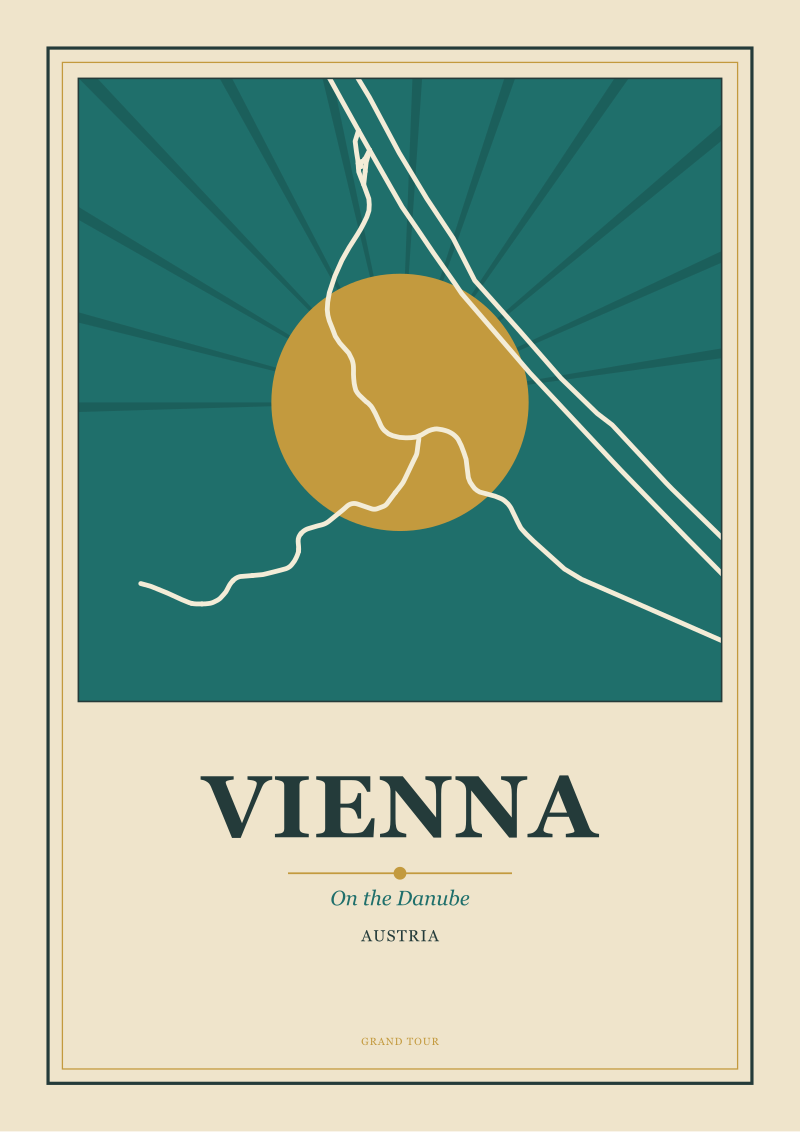
There is a reason the great travel posters of Vienna, when they finally arrived in the 1920s and 1930s, so often chose the cathedral spire and not the Ringstrasse. St. Stephen's is the medieval survival the ring did not touch. It is the one silhouette left from before the strike. Any poster that reaches for the older Vienna — the Vienna of Charles V, of the Ottoman sieges, of Mozart's arrival — reaches for that spire, because there is no other pre-imperial silhouette left to reach for. Our own poster of Vienna at see the Vienna print makes the same choice, and for the same reason: the drawable Vienna is the one the Ringstrasse did not overwrite.
The Ringstrasse cost Vienna its wall. What it gave back is a stage. That is the ledger, honestly kept.
If You Only Remember One Thing
The Ringstrasse is not a boulevard, and calling it one flattens almost everything interesting about it. It is a five-kilometre curated set, built at speed in the second half of the nineteenth century, by an empire spending money it did not really have, to make an argument it badly needed to make. Each building on it is a costume. The ring itself is the claim that all the costumes belong on one stage.
Walk it as a boulevard and it will disappoint you — the views are wrong, the scale is wrong, the buildings refuse to speak to each other. Walk it as political theatre and it becomes one of the most legible works of urban art in Europe. None of that tells you why Vienna, once the Ringstrasse was finished, spent the next thirty years producing Klimt, Schiele, Loos, Freud, Mahler, and Wittgenstein. That question is where the real work starts, and it is where this piece ends.
 Paris
The print from this article · from €29.95
View the print →
Paris
The print from this article · from €29.95
View the print →
FAQ
Why do so many guidebooks describe the Ringstrasse as a boulevard?
Because boulevard is a familiar tourist word that does not require the writer to explain nineteenth-century historicism or Habsburg politics. It also matches the surface facts — wide street, monumental buildings, trees — well enough to pass a casual reading. Our objection is that the word smuggles in a false comparison to Haussmann's Paris and hides what makes the Ringstrasse genuinely unusual: it is a ring, not a line, and it was commissioned as a coherent political argument, not a traffic solution.
Was the Ringstrasse built all at once or gradually?
It was built astonishingly fast by the standards of European urban set-pieces. The imperial decree came in 1857 and the major public buildings — Parliament, Rathaus, the two museums, the Opera, the University — were substantially finished by the end of the century. That is roughly one generation. Real boulevards accrete across centuries; the Ringstrasse was effectively a single project executed at speed, which is why it reads as a set rather than a street.
Why is each building in a different revival style?
Because each style was chosen to argue something specific about the function of that building. Neo-classical for parliament, neo-Gothic for the city hall, neo-Renaissance for museums and university, neo-Baroque for theatre. This nineteenth-century practice — called historicism — assumed the borrowed style would carry the idea. It is the single most important thing to know before walking the ring, and the thing most travel writing does not mention.
Did Vienna really tear down its medieval walls to build this?
Yes, and this is not a detail. The Ringstrasse occupies the exact ground of the fortifications and the surrounding glacis. Those defences had held off the Ottomans twice and were among the most complete surviving urban ramparts in Europe at the moment of demolition. The imperial decision to clear them was a deliberate trade of one kind of urban identity — walled Habsburg fortress — for another — imperial cultural capital.
Who criticized the Ringstrasse at the time it was being built?
The two names that matter most are Camillo Sitte and Adolf Loos. Sitte's 1889 book on urban planning argued that the ring's monumental buildings were undermined by the absence of proper piazzas and enclosures — it became a founding text of modern city planning. Loos attacked the era's ornamental façades in essays that helped launch European modernism. Neither is niche; both are still taught. The critique of the Ringstrasse is roughly as old as the Ringstrasse itself.
Is the Ringstrasse worth walking?
Absolutely, provided you walk it with the right expectation. Do not expect a Parisian axis or a single dramatic view. Expect a costumed procession of buildings each making a distinct nineteenth-century argument, arranged in a loop that lets you read them as a sequence. The best segment for a first walk is the stretch that carries the twin museums, the Parliament, the Rathaus, and the Burgtheater. That is the densest concentration of argument-per-metre in the entire ring.
Why do old Vienna posters usually show St. Stephen's Cathedral instead of the Ringstrasse?
Because St. Stephen's is a genuinely medieval silhouette and the Ringstrasse, however impressive, is a nineteenth-century revival. Travel poster artists in the 1920s and 1930s were looking for a single graphic shape that read as Vienna at a glance. The cathedral spire does that; a ring of stylistically incompatible façades does not. It is a design decision, not an aesthetic judgment on the ring itself.
New city prints and 10% off your first order.
One email now with your code. No noise after.