The question arrives in the studio most weeks, in some variation: what did people actually mean by Belle Époque travel? The phrase gets used as shorthand for a mood — steamer trunks, palm courts, sleeping cars sliding along a coast — but the mood was built out of specific words, each doing a specific job. A traveller moving from Chamonix down through Barcelona and Amsterdam toward the Amalfi Coast around 1900 passed through a vocabulary as structured as a railway timetable. Most modern writing on the period skips the vocabulary and keeps the mood, which is why the mood has gone slightly false. The glossary below is the one we keep on the studio wall.
The Grand Tour
The educational circuit that young men of means undertook through the eighteenth century, from northern Europe down through Paris, across the Alps, and into the classical cities of Italy. It matters because Belle Époque tourism did not invent the idea of leaving home for culture — it inherited a fully formed curriculum and put it on rails.
The Grand Tour prescribed the destinations, the order, the drawing folios one was supposed to fill, the ruins one was supposed to sit among. By the time a Parisian couple boarded a train for the Amalfi Coast in 1898, they were following, at higher speed and greater comfort, a route their great-grandparents had taken on horseback. The vocabulary is worth keeping straight: the Grand Tour was aristocratic, slow, and pedagogical. Belle Époque travel was bourgeois, fast, and consumptive. What connects them is the assumption that certain places were not optional — that a life without them was, in a specific sense, unfinished.
Wagon-Lits
The Compagnie Internationale des Wagons-Lits, founded in Belgium in the 1870s, was the private operator that built and ran the sleeping cars threaded through the railway networks of Europe. The company is the reason a traveller could go to bed in one country and wake up in another without changing trains.
Wagon-Lits mattered because it turned distance into a night's sleep. A Parisian bound for the Italian coast did not experience the journey as a series of connections; they experienced it as a supper, a cabin, a valet knocking with coffee at a station near the sea. The company's most famous service, the Orient Express, has swallowed the popular memory of the rest, but the ordinary work of the fleet — the Calais–Mediterranean routes, the sleepers that fed Chamonix in summer and the coast in winter — is where the real transformation sat. Before Wagon-Lits, going far was an ordeal to be recovered from. After it, going far was itself an interior, upholstered, staffed. The itinerary became the address.
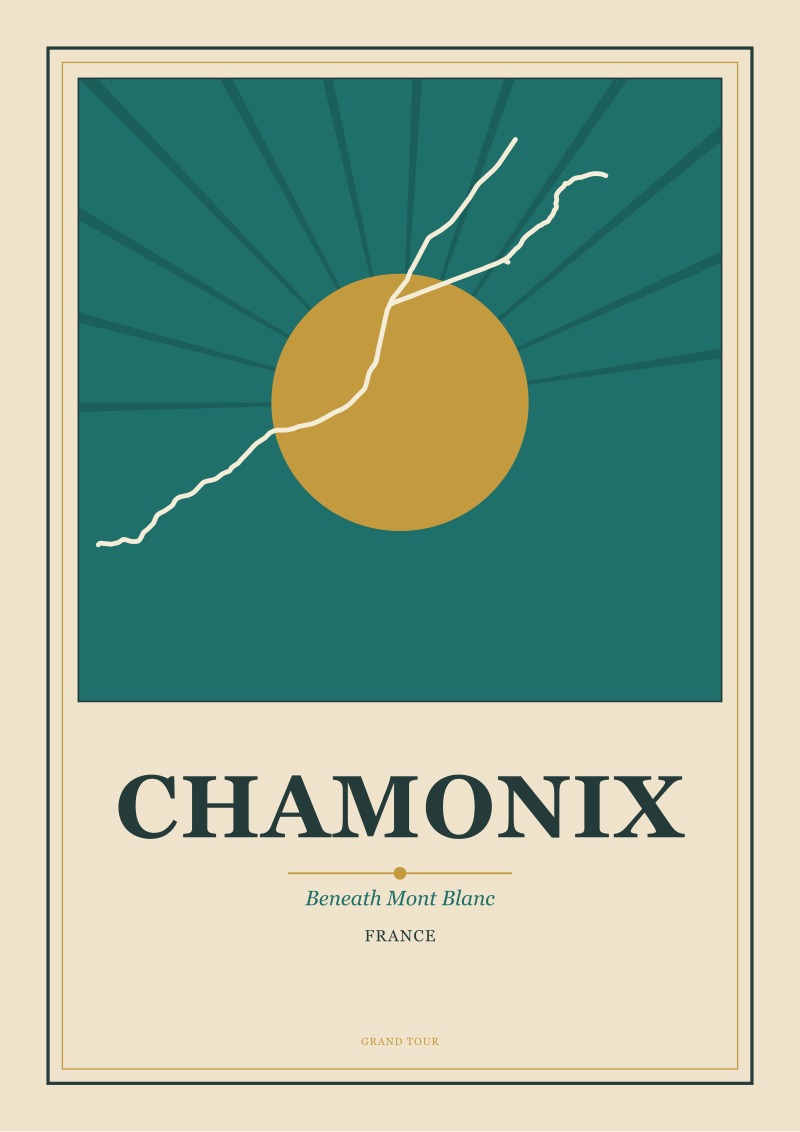 Chamonix
The print from this article · from €29.95
View the print →
Chamonix
The print from this article · from €29.95
View the print →
Baedeker
The small, red, cloth-bound guidebooks published in Germany from the 1830s onward, and dominant across Europe by the end of the century. To carry a Baedeker was to carry a consensus about what one should look at, in what order, and for how long. The books were dense with practical detail — hotel ratings, walking times, museum floor plans — and pitched at a traveller who wanted the confidence of preparation without the burden of scholarship.
Baedeker mattered because it standardised the eye. Two strangers arriving in Amsterdam in 1902 with the same red volume in a coat pocket would circle the same canals in the same sequence, note the same houses, form comparable impressions. The star system the books used — one star for worth seeing, two for detour-worthy — is the direct ancestor of every travel rating that has followed. The Belle Époque traveller did not so much explore a city as verify it, page by page, against a text already agreed upon at home.
The Season
The unwritten calendar that told anyone with means and mobility when to be where. Winter on the coast, spring in Paris or the great capitals, summer in the mountains or by northern water, autumn returning south. The Season was neither weather nor coincidence; it was a social clock, kept in step by the same families who kept in step at home.
In practice the year had a shape. Chamonix filled through July and August, when the glaciers were legible and the passes clear. The Amalfi Coast and the winter coast of the Mediterranean drew the same milieu from December through March, when northern Europe was unlivable and southern light was cheap. Barcelona sat awkwardly on the Season's map — a working port and a Catalan capital rather than a resort — and drew a more curious kind of traveller for it. Amsterdam belonged to spring and early summer, when the canals photographed well and the light on brick behaved. The Season is the reason Belle Époque posters so often name a month.
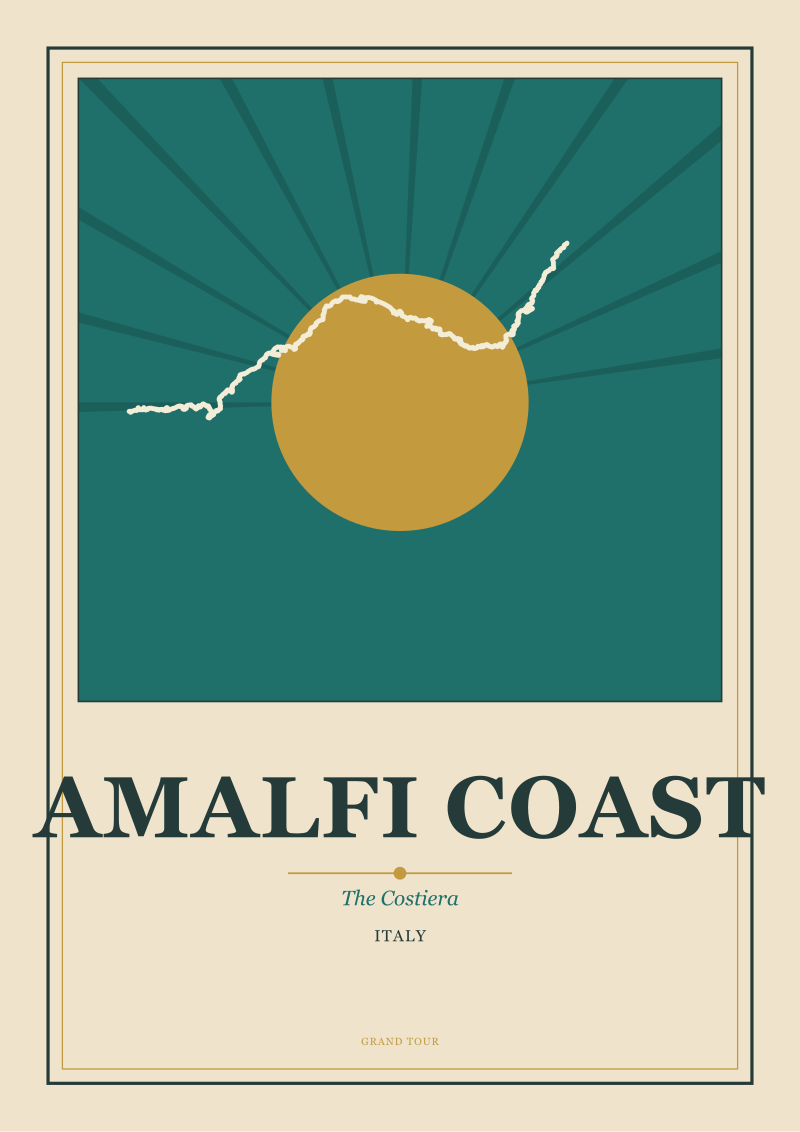 Amalfi Coast
The print from this article · from €29.95
View the print →
Amalfi Coast
The print from this article · from €29.95
View the print →
The Cure
The medicalised reason for going somewhere. A cure meant taking the waters at a spa town, or the air at an altitude, or the sun at a coast, on the orders — or at least the encouragement — of a physician. The vocabulary of the cure gave nineteenth-century travel a straight face. One did not go to the Mediterranean for pleasure; one went for the lungs.
The cure mattered because it built infrastructure. Whole towns organised themselves around a chalybeate spring, a pump room, a promenade of prescribed length. Coastal resorts on the Amalfi Coast and along the French and Italian Rivieras absorbed the same logic in warmer form: the sea bath, the sun terrace, the hour of walking before lunch. The mountains around Chamonix received a variant of the same argument — clean air, high pressure, the treatment of the tubercular. Modern wellness tourism is a direct descendant of this vocabulary, minus the physicians. It is worth remembering that the palm-court hotel was, in its own account, a clinic.
The Riviera
An invented coastline. The Riviera was not a country, a province, or a natural region; it was a marketing category coined to bind a stretch of Ligurian and Provençal shore into a single, marketable idea. By the Belle Époque, the term had hardened into a place people believed in.
The Riviera mattered because it demonstrated that a coast could be authored. Railway companies, hoteliers, and the poster artists who worked for both agreed, over three decades, on a palette — cobalt water, ochre villas, umbrella pines — and a promise: winter without winter. The Amalfi Coast, further south and geologically distinct, was folded by extension into the same imaginative territory, even though its cliffs and its Byzantine hill towns did not belong to the same story at all. This is a useful lesson in what tourism actually manufactures. It rarely invents landscapes. It invents the frame around them, and then insists the frame is the landscape.
The Grand Hotel
A specific building type that emerged in the second half of the nineteenth century and reached its full form in the Belle Époque: large, symmetrical, faced in pale stone or stucco, oriented toward a view, and organised internally around a public foyer meant to be seen from. The Grand Hotel was not simply a bigger hotel. It was a stage.
Its importance is that it made the destination a place one arrived at rather than merely reached. Before the Grand Hotel, an inn was where one recovered from the journey; the town was the experience. After it, the hotel itself was the experience, and the town became, in a subtle but real sense, a garden around the hotel. The Amalfi Coast still shows this in stone: buildings pitched over water, terraces cut for the view. Chamonix shows it in a different register, its Belle Époque hotels lifted to face Mont Blanc as if the mountain had been arranged for the dining room. Every subsequent luxury resort format is a variation on this template.
Alpine Sublime
The aesthetic conviction, inherited from Romanticism and industrialised by tourism, that high mountains were scenery — objects of contemplation and pleasure — rather than obstacles to be crossed. The word sublime carried a technical meaning: beauty edged with terror, a scale that reduced the observer.
Chamonix is the case study. Set beneath Mont Blanc and threaded by the river that drains the massif, the town was, until the eighteenth century, a place travellers went through and complained about. Within a hundred years it had become a place travellers went to and paid for the privilege. The vocabulary of the Alpine Sublime — the viewpoint, the panorama, the guided ascent, the glacier as spectacle — was the mechanism of that inversion. Belle Époque posters made the aesthetic portable: a triangular white peak, a foreground of pine and figure, a sky so blue it could only be printed. What the poster promised, the railway then delivered. The mountain, in effect, was drawn before it was climbed.
Chromolithograph
The colour printing process, based on multiple stone plates each carrying a single colour, that made the Belle Époque look the way it looks in memory. Chromolithography was industrialised through the nineteenth century and reached extraordinary sophistication in the poster work of the 1890s and 1900s. It is why the era's imagery is so saturated, so flat, and so instantly readable.
The process mattered because it made images cheap in bulk and beautiful at scale. Railway companies commissioned chromolithographic posters to advertise routes; hotels commissioned them for lobbies and luggage labels; steamship lines commissioned them for booking offices. A traveller moving through the Belle Époque was moving through a continuous printed environment — menus, timetables, tickets, guides — produced by the same technology and sharing the same visual grammar. When we speak of the look of Belle Époque travel, we are largely speaking of what chromolithography could do: bold outlines, unmixed colour, an image reduced to its most drawable elements. The studio's own poster work at see the Chamonix print is descended, directly and unashamedly, from that grammar.
Kept together on a wall, these nine terms describe a system, not a mood. Each one solved a specific problem — how to move a body, how to justify the trip, how to know what to look at, how to remember it afterward — and each one built the next. The mood came later, once the machinery had disappeared into the background and left only the palm court, the sleeping car, the poster of a coast.
FAQ
When exactly was the Belle Époque, and does travel history use the same dates?
The term is a retrospective one, applied after the First World War to the roughly three decades before it — call it the 1880s through 1914. Travel historians tend to use the same window because it maps neatly onto the maturity of the European railway network, the peak of chromolithographic poster production, and the full institutional life of the Grand Hotel and the Wagon-Lits sleeping car. Outside that window, the vocabulary in this glossary still exists, but it does not yet compose into a single system.
Was Belle Époque travel really as democratic as the posters suggest?
No, and the posters are part of the problem. Railway and hotel companies advertised widely and depicted a broad, aspirational public, but the actual clientele of a Wagon-Lits sleeper or a Grand Hotel on the Amalfi Coast was narrow: professional and industrial bourgeoisie, minor aristocracy, and the wealthier end of the emerging middle class. The Season, the cure, and the Baedeker itinerary all presupposed a level of leisure and disposable income that most Europeans did not have.
Why does Amsterdam sit slightly outside the standard Belle Époque itinerary?
Amsterdam was a working commercial city, not a resort, and its climate did not fit the Season's winter-south, summer-north logic in any tidy way. It attracted a different traveller — one interested in seventeenth-century painting, canal geometry, and the working ports of the North Sea — rather than the health-and-scenery circuit that connected Chamonix to the Riviera. Its Belle Époque presence in guidebooks is real but shaped by culture and trade rather than by the cure or the coast.
What is the difference between the Riviera and the Amalfi Coast in this period?
The Riviera was a marketing category assembled around the Ligurian and Provençal shore, sold as winter warmth to northern Europeans. The Amalfi Coast, further south, has a distinct geology of vertical cliffs and hill towns, and it entered the same imaginative territory largely by extension rather than by strict definition. Belle Époque posters often treated the two as versions of one idea, which is misleading if one looks at the actual landscape.
How central were guidebooks to the actual experience of travel?
More central than a modern reader might guess. A Baedeker was not a supplement to the journey; it was, for many travellers, the script of it. The books ranked sights, prescribed routes through cities, and effectively decided which views counted as views. This is why Belle Époque descriptions of places sound uncannily similar across different writers — they were, in a real sense, reading the same book while they looked.
Did Chamonix invent modern mountain tourism?
Chamonix did not invent it single-handedly, but it is the clearest early case of the pattern. Set beneath Mont Blanc, the town transitioned within roughly a century from a place travellers avoided to a place they specifically sought, propelled by the aesthetic of the Alpine Sublime, the arrival of the railway, and the construction of hotels oriented toward the view. Later Alpine resorts, and later mountain tourism worldwide, largely followed the template Chamonix worked out first.
Why do so many surviving Belle Époque travel images look alike?
Because they were produced by the same technology, for related clients, aimed at the same eye. Chromolithography rewarded flat colour, strong outline, and radical simplification, and railway and hotel companies wanted posters that read at a distance and travelled well across languages. The result is a shared visual grammar — a coast reduced to three colours, a mountain to a triangle — that we now recognise as the Belle Époque style, even though it was, in its day, simply what the printing process did best.
New city prints and 10% off your first order.
One email now with your code. No noise after.