How did a night train out of a Paris terminus become the century's most durable image of what luxury travel looks like? At 7:30 p.m. on 4 October 1883, a train the printed timetables still called the Express d'Orient rolled out of the Gare de l'Est bound for Giurgiu on the Danube, carrying roughly forty passengers and the ambition of a Belgian engineer named Georges Nagelmackers, who had spent more than a decade persuading five national railways to let his Wagons-Lits sleeping cars cross their borders unchanged. The train was not yet the Orient Express. The route was not yet a myth. Both would arrive in due course.
October 1883: The Inaugural Run From the Gare de l'Est to the Danube
The inaugural service was, in practical terms, an experiment in interoperability more than in luxury. Nagelmackers had founded the Compagnie Internationale des Wagons-Lits in 1872 with the modest but stubborn insight that a paying passenger should not have to change trains at every frontier just because each state railway ran on its own operating agreements. To carry that idea from Paris to the Black Sea he needed treaties with the French, German, Austro-Hungarian, Serbian and Romanian networks, each of whom had reasons to be difficult and none of whom saw an obvious benefit in ceding platform time to a private Belgian operator's sleeping cars.
The invited press corps on the first run recorded what the marketing material already implied: table linen, gas-lit dining cars, wine service, and berths that folded into upholstered day-seats. The train reached Munich, Vienna, and Budapest on printed schedule, then Bucharest, then the small Danube port of Giurgiu, where passengers disembarked, took a ferry across the river to Ruse in Bulgaria, boarded a second train to the Black Sea at Varna, and finally sailed the last leg to Constantinople. Total journey time was roughly eighty hours. The name on the carriage boards was Express d'Orient. The Anglicised Orient Express would not appear officially for another eight years, though French newspapers were already using it interchangeably by the second season. Everything about the service was legible as an argument: that the continent could be crossed as a single room.
June 1889: The Line Reaches Constantinople and the Name Sticks
The break at Giurgiu was, from a marketing standpoint, the whole story's weakest sentence. A luxury service whose climax was a ferry transfer and a change of trains was a compromise, and Nagelmackers knew it. The completion of the Bulgarian trunk line through Sofia to the Ottoman border finally allowed a continuous rail run, and on 1 June 1889 a Wagons-Lits train left Paris and arrived at Sirkeci station in Constantinople without its passengers ever having to leave the carriages. Journey time collapsed to roughly sixty-seven hours. The company formally adopted Orient Express as the branded name of the service that same year.
What this second act really did was convert a technical achievement into an idea. Sirkeci station, designed by the Prussian architect August Jasmund and opened in 1890 specifically as the eastern terminus, was built to receive the train as much as the passengers. Its Neo-orientalist arches and stained glass made an argument about what the destination should look like from the platform: the West's picture of the East, delivered on time. The Orient Express became, over the following decade, the reference case for how a railway route could produce a cultural image of the places it connected. Vienna, Budapest, Bucharest, Sofia, Istanbul: the timetable was also a bibliography. The train's regular passengers included diplomats, arms dealers, the occasional royal, and the writers who would later be blamed for its mythology. The route came first. The novels came after.
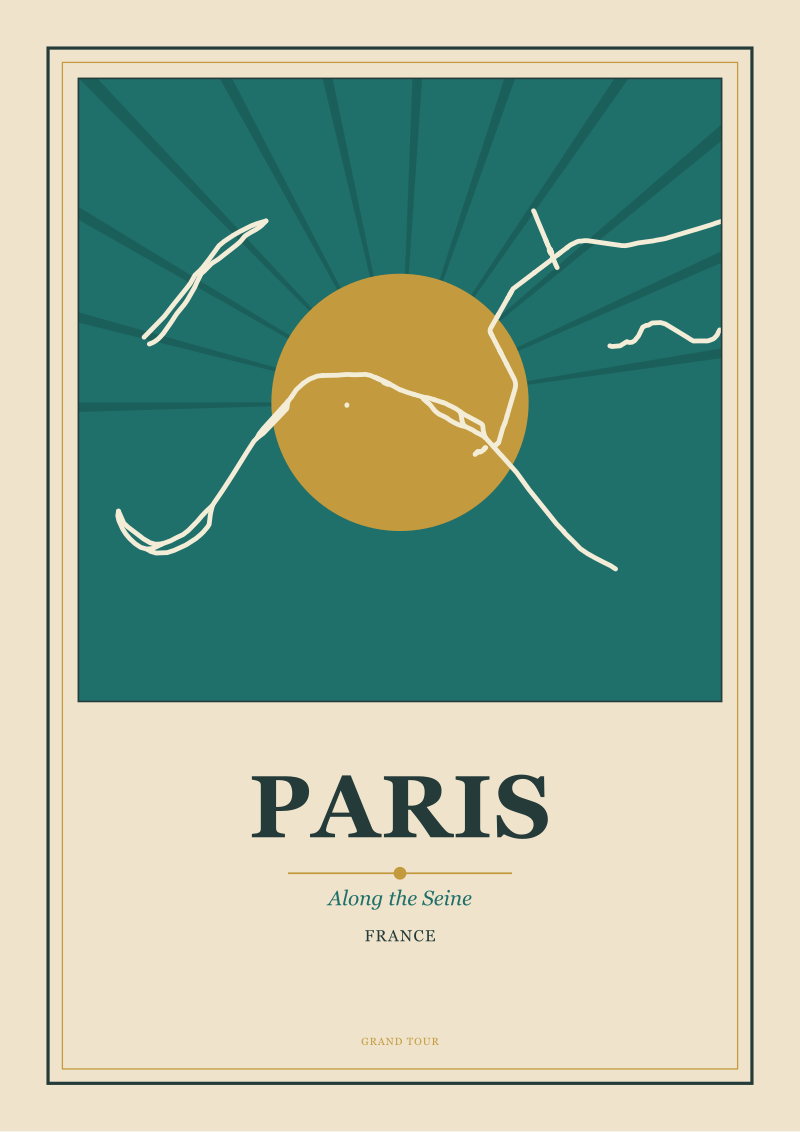 Paris
The print from this article · from €29.95
View the print →
Paris
The print from this article · from €29.95
View the print →
April 1919: The Simplon Route Redraws the Map After the War
The First World War closed the original route the way it closed a great many things: not with a policy decision but with a redrawn map. Austria-Hungary was dismantled. Germany was, for the purposes of the victorious Allies, an operator to be routed around rather than through. The Treaty of Saint-Germain-en-Laye, signed in September 1919, obliged the successor states to keep the through-carriage services running, but the French and Italian governments had already resolved that the flagship train should avoid German territory entirely on political principle.
The instrument was the Simplon Tunnel, the nineteen-kilometre bore under the Alps between Brig in Switzerland and Iselle in Italy that had opened in 1906 and was already Europe's longest rail tunnel. From April 1919 Wagons-Lits ran the Simplon-Orient-Express: Paris to Lausanne, then through the Simplon to Milan, then east across the Po plain to Venice, Trieste, Zagreb, Belgrade, Sofia and finally Istanbul. The old route via Vienna continued in a reduced form under the plain Orient Express name, but the Simplon variant was the one that carried the flag through the 1920s and 1930s. It was also the route that most people picture when they picture the train, because it was the route running when Agatha Christie boarded it in 1928 and 1931, and the route she set her 1934 novel on. The Simplon service is what put Venice inside the train's imagination and, by extension, inside the printed poster art that Wagons-Lits and its national partners commissioned throughout the interwar decades to sell the idea to travellers who would never board.
May 1977: The Last Direct Paris–Istanbul Sleeper Rolls East
Nothing about the train's decline happened suddenly. Postwar Europe had cheaper flights, faster diesel expresses, and progressively less patience for a service whose selling point was that it took three days. The through-cars were quietly dropped one segment at a time. The Athens branch was cut in 1962. The Simplon-Orient-Express as a named service ended in 1962 as well, replaced by a plainer Direct-Orient-Express that still ran Paris to Istanbul but with progressively fewer sleeping cars and no restaurant east of Milan.
The last direct Paris–Istanbul service departed the Gare de Lyon on 19 May 1977, some ninety-four years after the inaugural run. By then the train was, in practical terms, a set of couchette cars attached to whichever regional service happened to be heading in the right direction, and the meals were sold from a trolley or bought at station buffets. Passengers on that final departure were mostly rail enthusiasts and journalists writing the obituary in real time. What ended in 1977 was not the name — variants of the Orient Express continued to run under Wagons-Lits and later national operators until 2009, when the last vestigial service, a plain overnight sleeper between Strasbourg and Vienna, was withdrawn from the December timetable. What ended in 1977 was the specific act the 1883 service had introduced: the ability to board a single train in Paris and step off it in Istanbul without changing carriages. The through-route was gone. The idea of it, by then, had already outlived the operator.
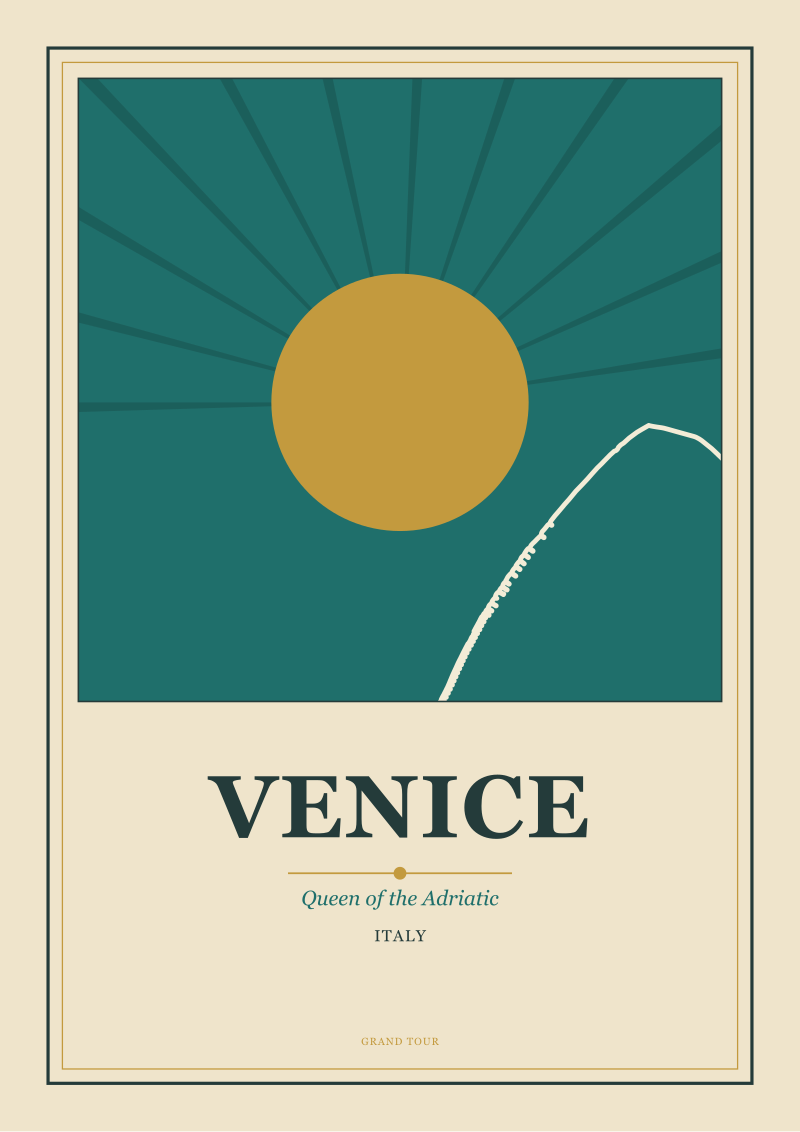 Venice
The print from this article · from €29.95
View the print →
Venice
The print from this article · from €29.95
View the print →
May 1982: The Venice-Simplon-Orient-Express Reboots the Legend
The 1977 obituaries had barely been written when an American shipping executive named James Sherwood began buying up the abandoned Wagons-Lits carriages that had been auctioned off after the service ended. His company Sea Containers acquired thirty-five sleeping and dining cars, most of them of interwar vintage, some literally rescued from siding tracks in Monte Carlo and Bologna. Restoration took roughly four years, at a reported cost of eleven million dollars, and the reborn service was launched on 25 May 1982 as the Venice-Simplon-Orient-Express, running London to Venice via Paris, Zurich, Innsbruck and the Brenner Pass rather than the Simplon itself.
The 1982 reboot was, and remains, honest about what it is: a heritage cruise on rails, not a transport service. It does not go to Istanbul except as an annual special. It does not attempt to reproduce a timetable that no living traveller has any commercial reason to want. What it reproduced instead was the interior — the Lalique glass panels in the Côte d'Azur dining car, the marquetry of the Étoile du Nord, the specific hush of a corridor with brass fittings and blue plush. What Sherwood understood, and what the current owners at Belmond continue to trade on, is that the Orient Express's cultural asset was never the speed or even the destinations. It was the room. The reboot preserved the room and let the route become whatever the passengers now wanted to see out the window. Paris, Verona, Venice: cities that had already been drawn into the myth by fifty years of Wagons-Lits poster commissions were, conveniently, still there to be drawn again.
What It All Means: A Train, a Poster, and the Shape of Longing
Read the timeline back and one thing becomes clear: the Orient Express was a route before it was a train, and a poster before it was a memory. Nagelmackers's original innovation was administrative, not aesthetic. He negotiated interoperability. What made the interoperability into an image was the parallel industry that grew up around the train: the station architects who built platforms as prosceniums, the graphic designers who put the train's carriage boards on posters, and the writers who set their plots inside the compartments because the compartments were already famous.
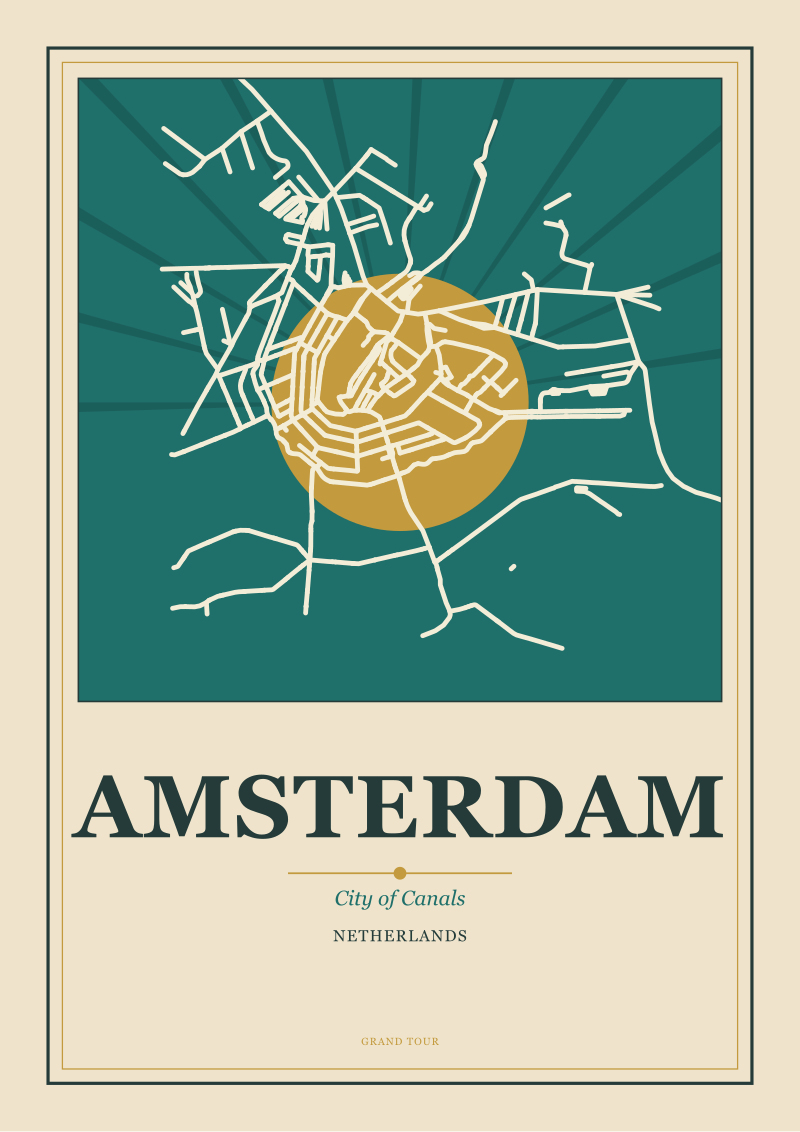
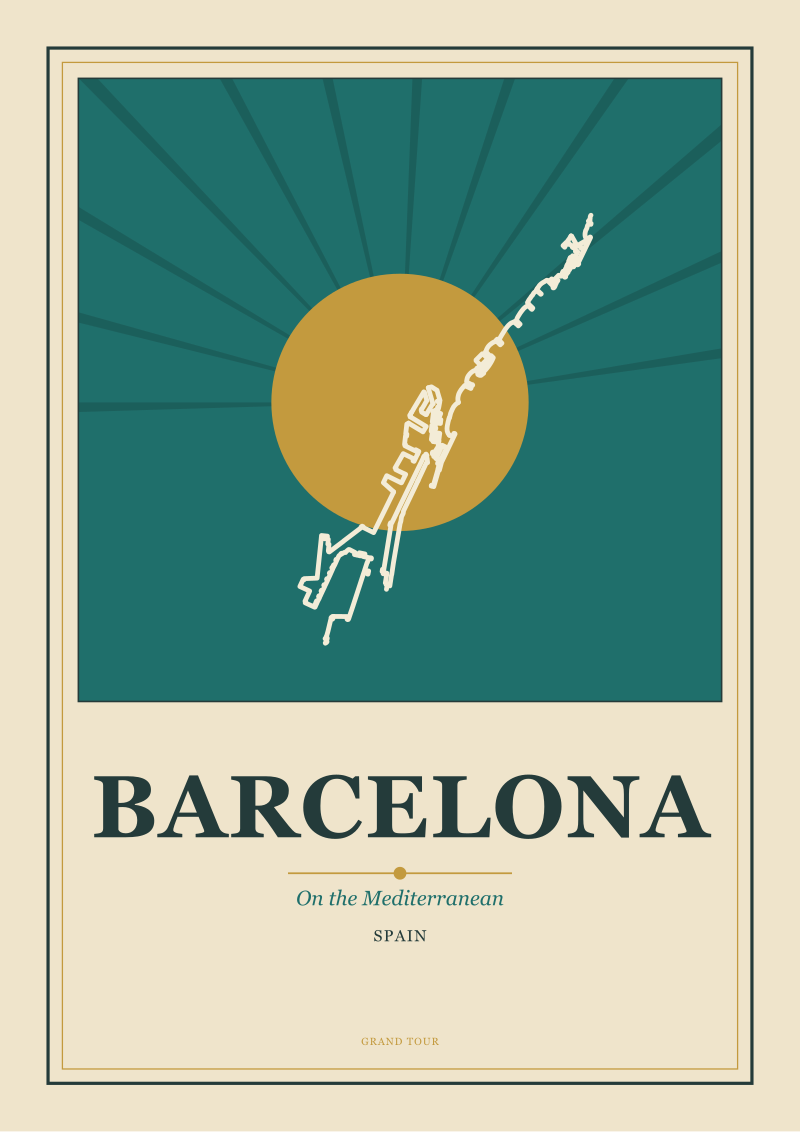
The route mattered because a train has to actually go somewhere. But the route's cultural half-life turned out to be far longer than the train's operating life. The Simplon variant put Venice into the story and, in doing so, wrote the coast and the lagoons into a tradition of travel imagery that persists in every guidebook cover and print-shop poster produced since. When we draw the cities the Orient Express served — from the Amalfi coastline the marketing extended toward, to the canal geometry of Amsterdam that shared the interwar poster boom, to the Mediterranean waterfront of Barcelona, to the alpine wall above Chamonix that framed the Simplon's own PR — we are drawing inside a visual convention that a Belgian sleeping-car company helped standardise between 1883 and 1939.
The lesson, if one is to be drawn, is that luxury travel as we now recognise it is a fifty-year interwar image with a nineteenth-century operating manual attached. The train is largely gone. The room, in the form of the 1982 reboot, survives. The poster art survives in every studio, ours included, that still draws European cities from their defining geographies rather than from photographs. That is the durable inheritance. The rest, including the ferry across the Danube in 1883, is footnote.
FAQ
When did the Orient Express actually start and stop running?
The inaugural service departed Paris on 4 October 1883, terminating at Giurgiu on the Danube with onward ferry and rail to Constantinople. Continuous rail service to Constantinople began 1 June 1889. The last direct Paris–Istanbul sleeper ran on 19 May 1977, and the final vestigial Orient Express–branded service, a Strasbourg–Vienna overnight, was withdrawn from the December 2009 timetable. A private heritage service under the Venice-Simplon-Orient-Express name has run since 25 May 1982.
What route did the original Orient Express take?
The 1883 inaugural ran Paris–Strasbourg–Munich–Vienna–Budapest–Bucharest–Giurgiu, with a ferry across the Danube to Ruse, a second train to Varna on the Black Sea, and a steamer to Constantinople. After the completion of the Bulgarian trunk line via Sofia in 1889, the train ran continuously by rail from the Gare de l'Est to Sirkeci station on the Bosphorus. The route was postally about eighty hours in 1883 and roughly sixty-seven hours after 1889.
Who founded the service and why?
Georges Nagelmackers, a Belgian engineer who had founded the Compagnie Internationale des Wagons-Lits in 1872, spent more than a decade negotiating carriage-through agreements with the French, German, Austro-Hungarian, Serbian and Romanian state railways. His premise was straightforward: a paying passenger should not change trains at each frontier. The Orient Express was the flagship demonstration of that idea, and Wagons-Lits ran comparable services elsewhere in Europe on the same principle throughout the following decades.
Why did the route change after the First World War?
The dismantling of Austria-Hungary and the French and Italian governments' political preference for avoiding German territory prompted a redrawn line. The Simplon-Orient-Express, launched in April 1919, ran Paris–Lausanne–Simplon Tunnel–Milan–Venice–Trieste–Belgrade–Sofia–Istanbul. The Simplon Tunnel had opened in 1906 and was the mechanism that made the reroute possible. The old Vienna route continued in reduced form, but the Simplon variant carried the brand's prestige through the interwar decades.
Is the Orient Express in Agatha Christie's novel a real train?
Yes. Christie travelled on the Simplon-Orient-Express in 1928 and 1931, and her 1934 novel Murder on the Orient Express is set on that specific service, snowbound on the Belgrade–Vinkovci stretch of the line. The Simplon variant, not the original Vienna route, is the train in the book. The novel arrived at a moment when the service was already saturated in reputation, and it fixed the image in popular culture for the ninety years since.
Is the current Venice-Simplon-Orient-Express the same train?
Not operationally, but partially so materially. The 1982 reboot was assembled by Sea Containers from thirty-five original Wagons-Lits sleeping and dining cars of interwar vintage, restored over roughly four years at a reported eleven million dollars. It is now operated by Belmond and runs primarily London–Paris–Venice, not the historical Paris–Istanbul line. The carriages are largely genuine 1920s and 1930s stock. The service is a heritage journey, not a scheduled transport link.
Why did the original service decline?
Postwar civil aviation, faster diesel expresses, and shifting overnight-travel economics made a three-day rail service commercially marginal by the 1960s. The Athens branch was cut in 1962. The Simplon-Orient-Express as a named service ended the same year, replaced by a reduced Direct-Orient-Express with fewer sleeping cars. The through-route to Istanbul ended in 1977, and the residual short-run services were withdrawn incrementally through 2009. The decline was administrative attrition, not a single closure event.
What role did poster art play in the train's mythology?
A significant one. Wagons-Lits and its national partners commissioned poster art throughout the interwar decades to sell the service to travellers who would never board, and the graphic vocabulary those posters established — deco lettering, cropped skylines, cities reduced to their defining geographies — became the template for how European destinations were subsequently depicted. The train's cultural asset was as much the printed image of its stops as the ride itself, which is why studios that still draw cities in that tradition, our shop included, are drawing inside a convention the Orient Express helped standardise.
New city prints and 10% off your first order.
One email now with your code. No noise after.