How did we get here — to the aisle of fridge magnets, novelty passport covers and airport-shop trinkets that has come to stand in for what we give the people we love who travel?
We spent a long autumn in the archives of poster houses and the sale catalogues of Grand Tour objects, trying to piece together the answer. What emerged was not a shopping list. It was a lineage. The idea that a place could be given as an object is roughly three and a half centuries old, and every serious travel gift alive today is a descendant of one of five specific moments. Below is that timeline, and what it asks of a gift chosen this year.
The 1670s: The Grand Tour Invents the Souvenir
The Grand Tour — a decades-long educational rite for young European aristocrats, mainly British, mainly male, moving south through France to Italy and sometimes further — is where the modern travel gift begins. Its participants left with an itinerary and returned with objects. Not accidents of a trip, but its curriculum in physical form: views of the Bay of Naples, prints of Roman ruins after Piranesi, small oil paintings of Venice, cameos, coins, botanical drawings, mineralogical samples. The Amalfi Coast, then already legendary among tour-makers as the southern edge of the classical world, generated a particular category of watercolours. Chamonix, still a village at the foot of Mont Blanc and unknown to most Europeans, produced almost none — its market would arrive a century later. Amsterdam, humming as a commercial capital, sat closer to the beginning of the northern loop and generated townscape prints.
The point worth holding is this: the Tourist did not merely bring home evidence of having been somewhere. They brought home a piece of the argument the trip was supposed to make. A gift, at the far end of the Tour, was a compressed thesis. The instinct that a place could be gifted, and that the gift ought to carry the argument of the place, is what has been intermittently forgotten and rediscovered ever since.
The 1880s: The Railway Poster Puts the Destination on the Wall
The train did two things to travel that concern us here. First, it democratised the trip — the Grand Tour had been a two-year expenditure available to perhaps a few thousand Europeans in any given decade; a train weekend to Boulogne or Como was available to hundreds of thousands. Second, and less remarked, it invented the mass image of a destination. Before the railway poster, a place existed in the mind of someone who had not been there mostly through prose, occasional engravings, and other people's paintings. After the railway poster, it existed as a graphic.
The French Compagnie du Chemin de Fer Paris-Lyon-Méditerranée — the P.L.M. — began commissioning lithographs advertising the Riviera in the last decades of the nineteenth century. The Chemin de fer du Nord did the same for the Channel coast and for Belgium. British companies — later the LNER — did the same for the Yorkshire coast and the Highlands. Amsterdam appeared on Dutch rail posters as a compact ring of canals. Barcelona, positioned at the end of the Spanish rail spine along the Mediterranean, began to be drawn — often crudely, in these first decades — as a coastal capital and not merely as a Catalan city.
The poster gave the wall a window. Once a wall could hold a window, a print of a place became giftable. This is the moment travel and interior decoration first married, and the marriage has never been annulled.
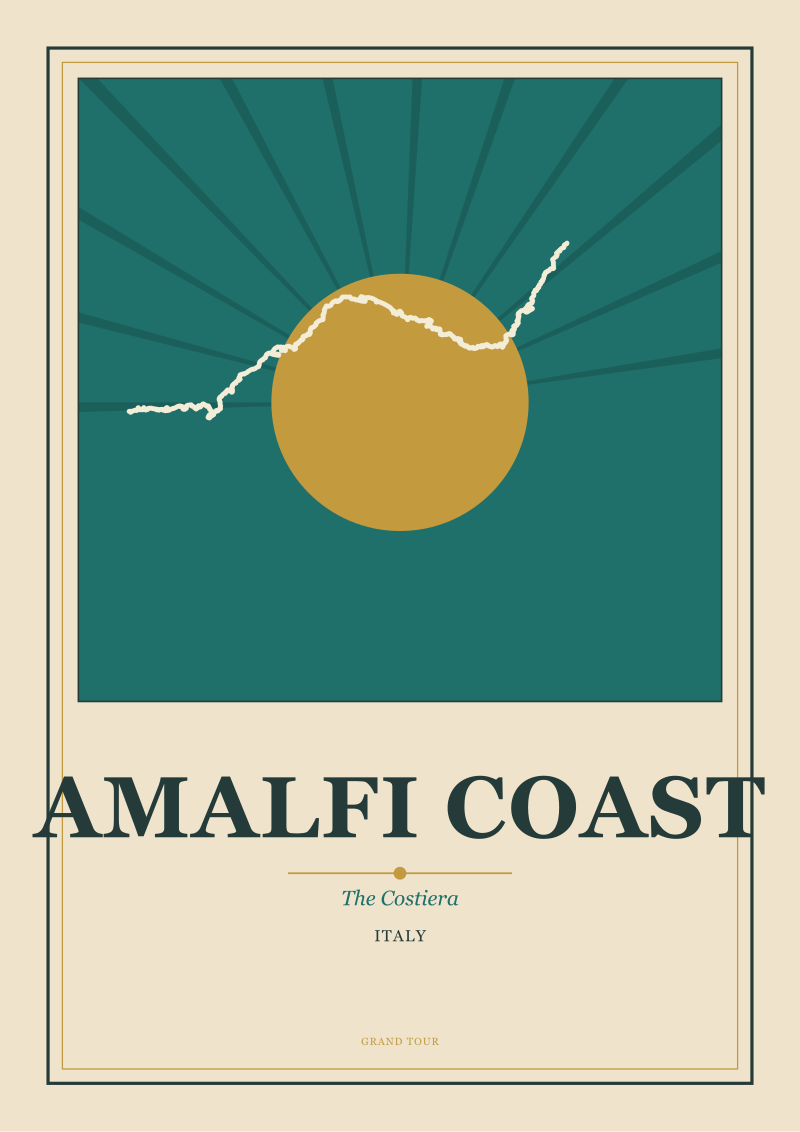 Amalfi Coast
The print from this article · from €29.95
View the print →
Amalfi Coast
The print from this article · from €29.95
View the print →
The 1920s: Art Deco Turns the Travel Poster Into an Argument
The golden age is compact. Roughly 1920 to 1939. The travel poster in those two decades was not a memento — it was a piece of graphic reasoning. Cassandre's Étoile du Nord, 1927, flattens the geometry of a night train's rails into perspective lines converging on a single star; it makes the argument that speed is a form of beauty. Roger Broders, working for the P.L.M. throughout the same decade, produced posters of the Côte d'Azur and of Alpine resorts including Chamonix in which snow, sea and shadow are reduced to two or three colour fields. The Alps become a shape; Nice becomes a promise.
The 1925 Paris Exposition Internationale des Arts Décoratifs, from which Art Deco takes its name, is the moment this visual language becomes international. Within a decade the same reductive, geometric, saturated poster grammar had spread to Britain, Austria, the United States, Japan. The important thing for our purposes is what this did to the gift economy of travel: it produced, for the first time at scale, an object that was both mass-produced and specifically authored. A P.L.M. poster designed by Broders was printed in thousands, but every print carried the signature of a designer's argument. This is the fusion — mass reproduction plus considered authorship — that a good travel gift still tries to sit on top of.
The 1960s: Jet Travel and the Death of the Careful Souvenir
The Boeing 707 flew its first commercial route in 1958. Within a decade the mechanics of travel had inverted. Where the Grand Tour had taken two years and the Belle Époque train weekend had taken a Friday afternoon, jet tourism took hours and cost, by the mid-1960s, less than a month's wages for a growing European middle class. The Amalfi Coast, once a Grand Tour terminus, became reachable from London in an afternoon. Barcelona's Ramblas — a promenade cut through a medieval quarter — filled with visitors in numbers the city had never planned for. Amsterdam's canal houses appeared on postcards printed by the ten thousand.
The souvenir contracted with the trip. Volume killed care. What replaced the considered object, in the tourist shops that now lined the Amalfi Coast road and every Barcelona plaça, was the fridge magnet, the snow globe, the plastic gondola, the miniature Eiffel Tower, the printed T-shirt with a slogan a native speaker would not have written. None of these objects had authors. None of them had arguments. They were tokens of having-been-there, and only that.
The reason so many travel gifts today feel wrong is not that they are cheap. Cheap has always been available. The reason is that the entire tradition of authored, considered travel objects went dark for roughly four decades, and most of the shelf-facing gift industry has not remembered it.
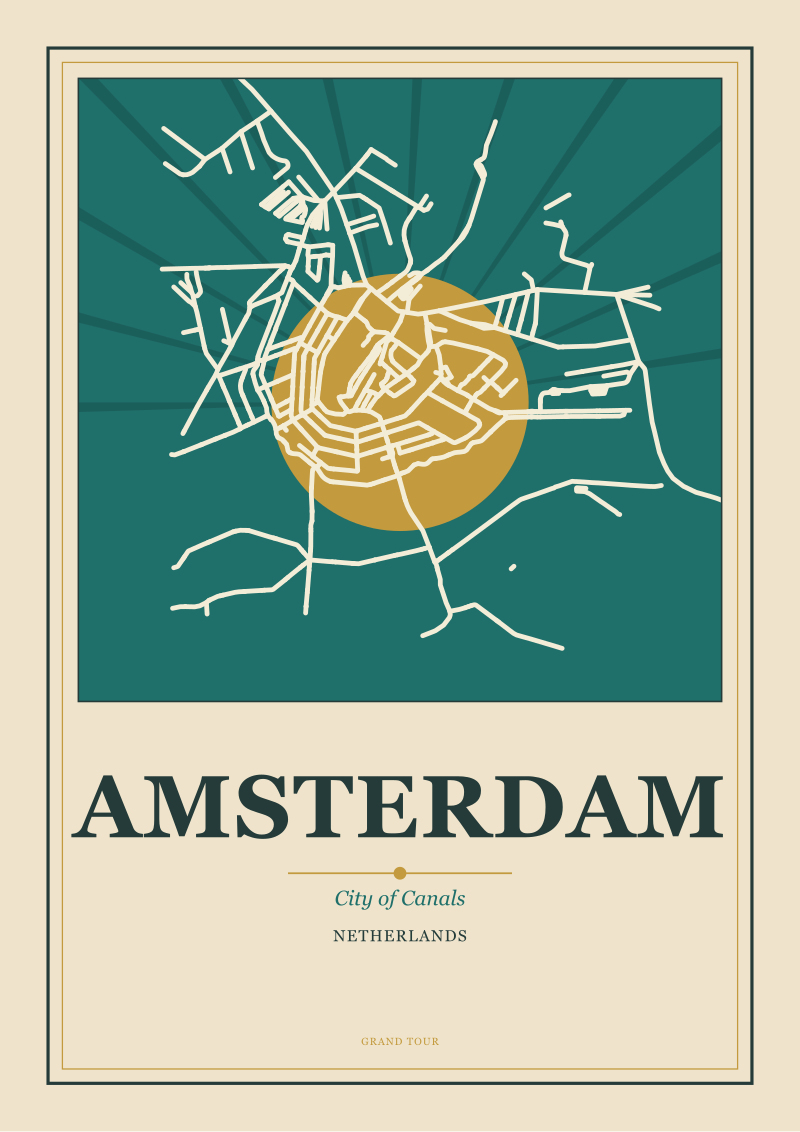 Amsterdam
The print from this article · from €29.95
View the print →
Amsterdam
The print from this article · from €29.95
View the print →
The 2010s: The Return of the Considered Object
Something turned around fifteen years ago. It is difficult to date precisely, and we would resist any single origin claim, but the movement is unmistakable. Instagram, launched in 2010, converted places into images faster than any technology in history. Fast travel became easier than fast returning-from-travel-with-something-good, and the mismatch created an appetite. A small ecosystem of independent print studios began drawing cities again, from geography rather than from stock photography, in the reduced-colour vernacular of the Art Deco travel poster. Small-batch shops on Etsy and elsewhere; letterpress studios reviving Belle Époque engraving; contemporary illustrators taking commissions to render specific streets and coastlines.
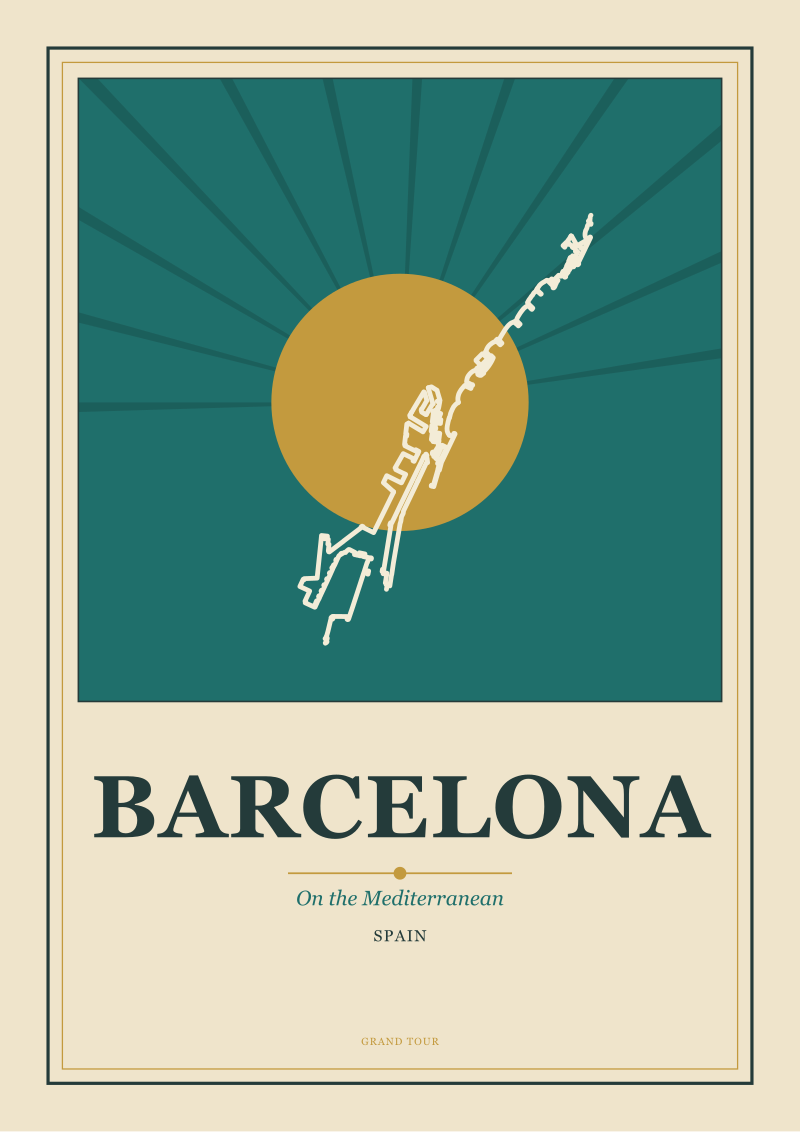
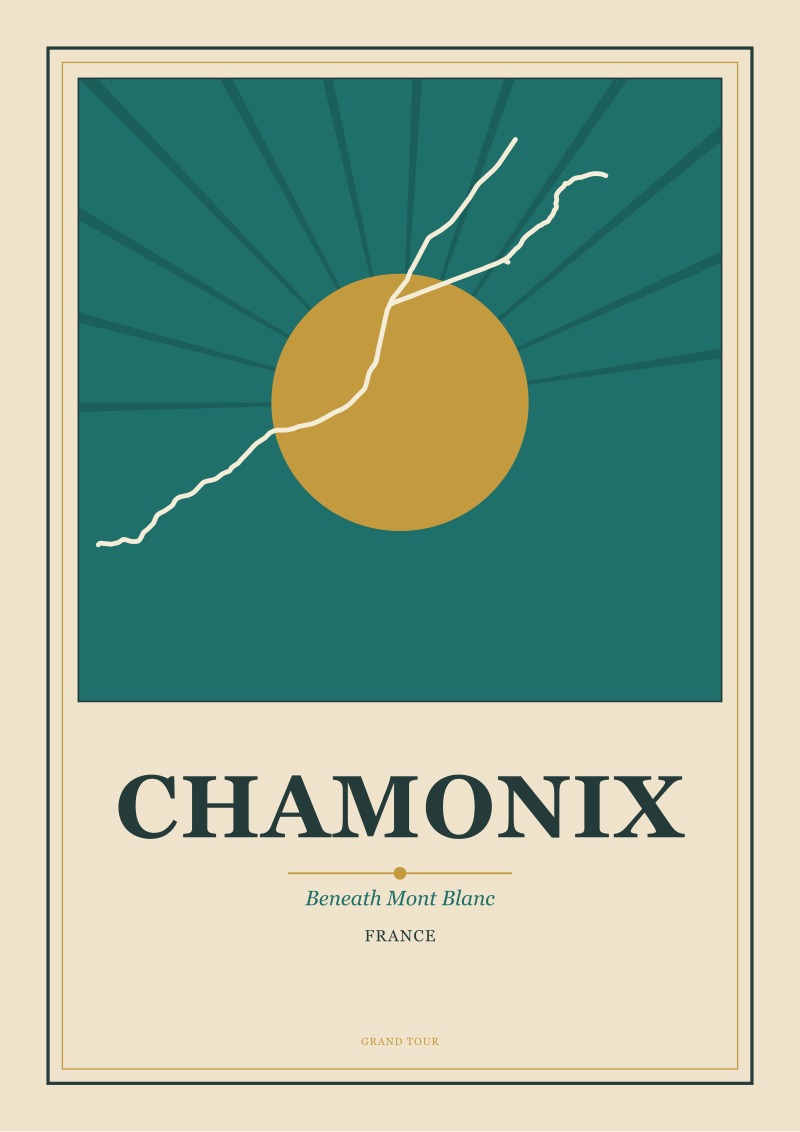
This is the generation the current considered travel gift belongs to. A print of the Amalfi Coast drawn from the road that carves along its cliffs. A section of Amsterdam's canal ring rendered as concentric arcs. Chamonix reduced to the wedge of Mont Blanc above a valley floor. Barcelona drawn from above so the Eixample's grid reads as the piece of graphic design it was intended to be from 1859 onward. The revival is not nostalgic in the sneering sense. It is a return to the fusion the 1920s figured out: reproducible object, specific author, argument about the place.
What It All Means
Three and a half centuries of the travel gift, compressed, teach one useful thing. The gifts that hold up over time — the ones the recipient still has on a wall or a shelf in a decade — share a single property, and it is not price and it is not size. It is that they carry an argument about the place. The Grand Tour print of the Bay of Naples argued that classical antiquity survived in the light on the water. The Cassandre poster argued that the night train to the Riviera was itself a beautiful object. The considered contemporary print of Chamonix argues that a mountain is best understood as the geometry above a village, not as a summit photograph.
The gifts that do not hold up are the tokens. The fridge magnet is a token. The keychain is a token. The novelty passport cover is a token. They register that a trip happened; they do not say anything about the place the trip went to. This is why they end up in drawers, and why the recipient — even if they were briefly delighted — will not remember, five years on, who gave what.
For the person choosing a gift for someone who travels this year: the useful question is not what the recipient likes. It is what argument you want the object to carry about the place. If you cannot answer that in one sentence, the object will not hold. If you can — the Amalfi Coast is a road drawn along a cliff, Amsterdam is a set of concentric water arcs, Chamonix is a village looking up, Barcelona is a grid at the edge of a sea — then almost any authored, well-made object built around that sentence will do the work of a good travel gift. The tradition has always known this. The gift industry, for four decades in the middle of the last century, forgot it. We are now, slowly, remembering.
This piece did not cover the specific question of gifting objects to someone about to travel, as distinct from someone returning — the etiquette there is different and the object categories tilt toward the practical, and that is a separate argument. It did not cover custom commissions, in which the argument is authored specifically for a private recipient — a category that has its own economics and its own risks. And it did not cover the deeply personal case of gifting a place to someone who has not been there, which is a more delicate act than the industry acknowledges. Each of those deserves its own study.
FAQ
Why do prints and posters keep working as travel gifts when most other souvenirs do not?
Prints inherit the fusion the 1920s travel poster figured out: they are reproducible enough to be affordable and specific enough to carry an author's argument about a place. Objects that lack one of those two properties fail as gifts — a fridge magnet is reproducible but has no argument, a custom oil painting has an argument but the price puts it outside gifting range for most people. A well-made print sits on the intersection, which is why the format has survived three revivals across a century and a half.
Is a travel gift better when it's a place the recipient has been, or a place they want to go?
Both work, but for different reasons. A print of a visited place operates as compressed memory — it makes the argument of the trip legible on a wall for years afterwards, which is what the Grand Tour souvenirs were designed to do. A print of an unvisited destination operates as intention. It sits on the wall as a small standing statement that this place matters enough to look at every day. The gift industry treats these two as interchangeable; they are not.
Are travel posters and travel prints only for European destinations?
No, though the deepest tradition is European because that is where both the Grand Tour and the Belle Époque railway poster were invented. The visual grammar — reduced colour fields, geometric flattening, argument-as-image — travels well to any destination that has a strong defining geometry: a coastline, a river, a mountain, a grid. The medium is not the continent; the medium is the shape of the place.
What makes a travel gift feel considered rather than generic?
Three tests hold up. First, would the recipient be able to name the specific place from the object alone, without the caption? Second, is the object authored — does someone's hand show, whether an illustrator, a printmaker, a letterpress operator? Third, does the object make an argument about the place that a photograph could not make? A gift that passes all three feels considered. A gift that fails any of them tends to end up in a drawer within eighteen months.
Are the Grand Tour and the modern travel gift really connected, or is that a rhetorical stretch?
The connection is material, not rhetorical. The Grand Tour established, at scale, the market for authored objects that argued about specific places — vedute of Venice, prints of Rome, watercolours of the Amalfi Coast. That market never entirely disappeared; it contracted during the mid-twentieth-century tourism boom and expanded again with the independent-studio revival of the 2010s. The current wave of considered travel prints is a direct descendant, not an imitation.
Does giving someone a poster of a place they've been reduce the memory to a cliché?
Only if the poster is a cliché — which is a criticism of the specific object, not of the format. A print that draws a place from its actual geometry (the coast road, the canal ring, the mountain above the valley) tends to deepen memory rather than flatten it, because it names the visual argument the trip was built around. The clichés are the objects that could have been printed for any city with the name swapped out.
What did travellers of the Grand Tour era actually bring home as gifts?
The category was broader than most modern shoppers expect. Alongside the well-documented vedute and Piranesi prints, travellers carried home coins, cameos, small oils, botanical illustrations, mineralogical specimens, drawings of ruins, and — in the later part of the tradition — bound sketchbooks of the whole itinerary. The unifying property was that the objects were authored, portable, and organised around specific places. The modern print is a distilled, more affordable version of the same idea.
New city prints and 10% off your first order.
One email now with your code. No noise after.