We spent a season laying railway posters from the golden age of travel art across modern route maps of four European corridors — the Costiera line, the Dutch canal ring approach, the Mediterranean coastal run into Barcelona, and the valley climb to Chamonix beneath Mont Blanc. The overlap is not decorative. Of the destinations that survived a century as drawable rail journeys, each is defined by one geographic feature: a coastline, a river, a coastline, a river again. That is the finding. This piece is a flowchart in prose. We will ask three questions. Each answer routes you toward one of those four places, for reasons that are geographic before they are romantic.
Question 1: Are You Drawn to a Coast or to a Mountain?
Before you choose a route, choose an elevation. Every great rail journey in the poster archive resolves to one of two silhouettes: a line of water meeting land, or a line of stone meeting sky. Coast posters use horizontal composition. Mountain posters use vertical composition. This is not a stylistic preference; it is what the geography permits the artist to draw. Ask yourself which silhouette you have been carrying around in your head when you imagined "the trip."
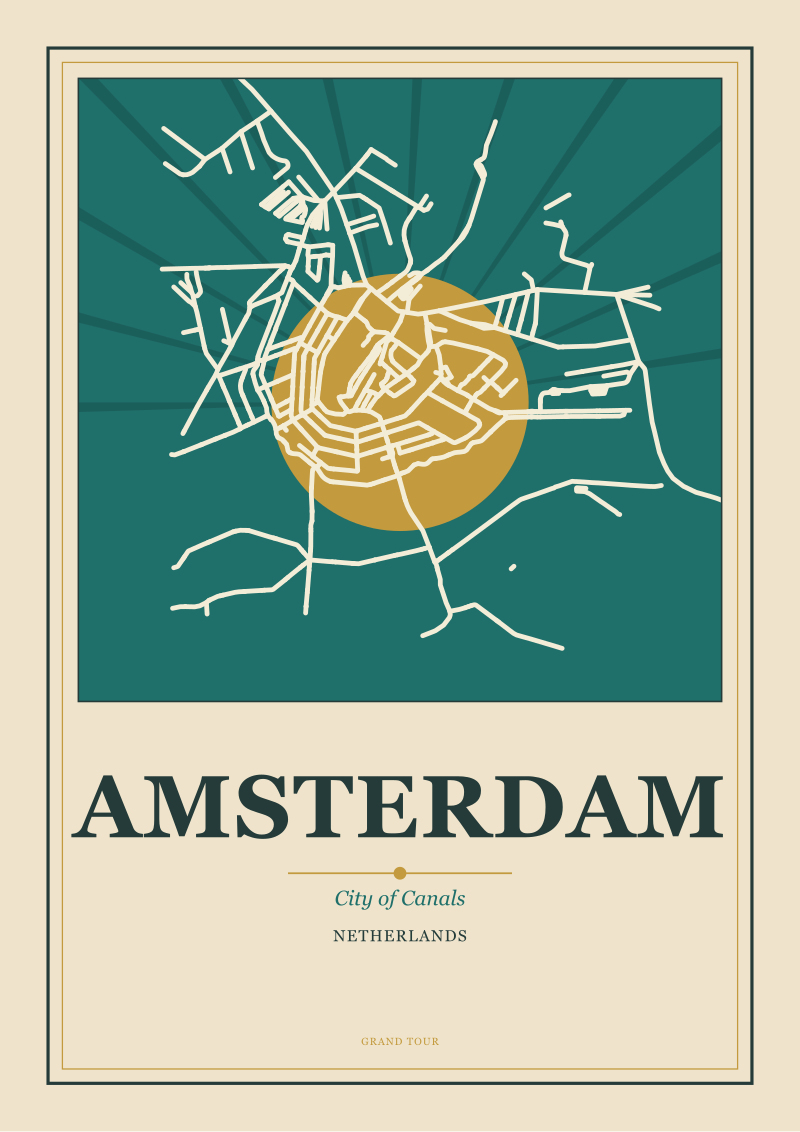
We include a second reading of the mountain answer, because it matters. Mountain, in poster grammar, is any place where the vertical dominates the horizontal — alpine peaks, of course, but also cathedral spires, gabled canal fronts, church towers stacked against low sky. A city can be a mountain if it is drawn upward. Amsterdam is a mountain in that sense, its verticality supplied not by rock but by the cornice line of the merchant houses over water. Hold both readings in mind while you choose.
If Coast
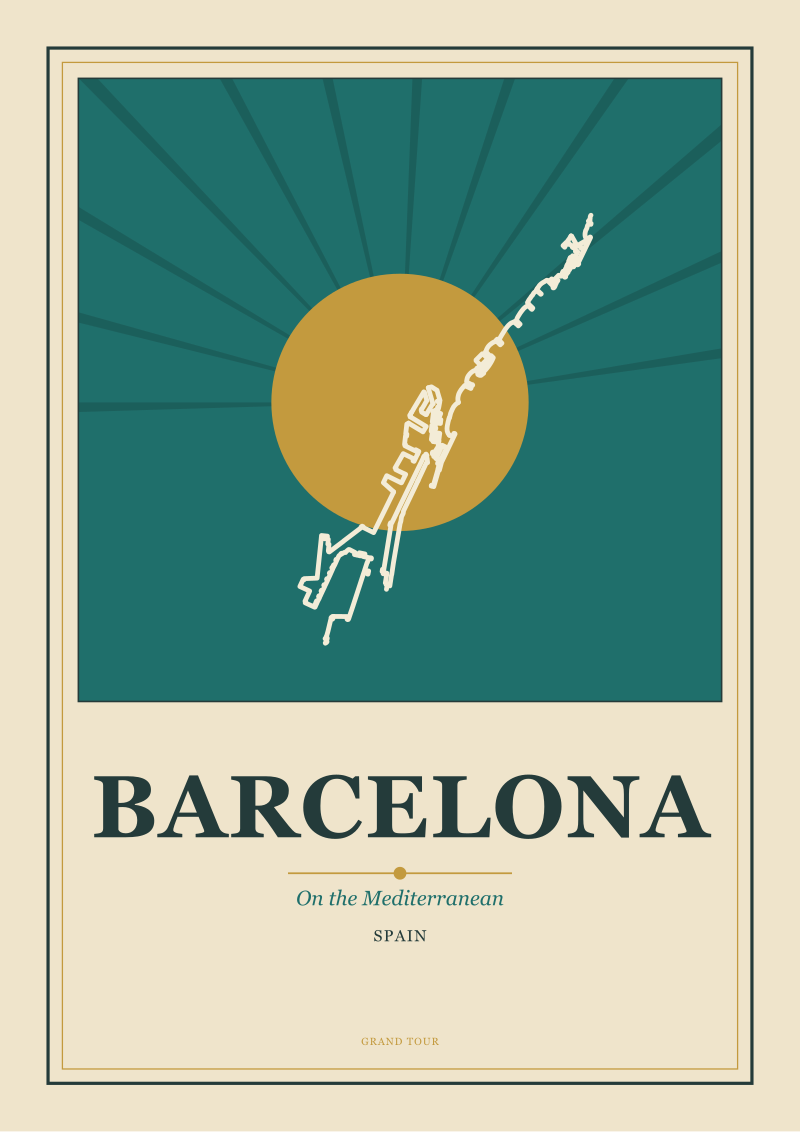
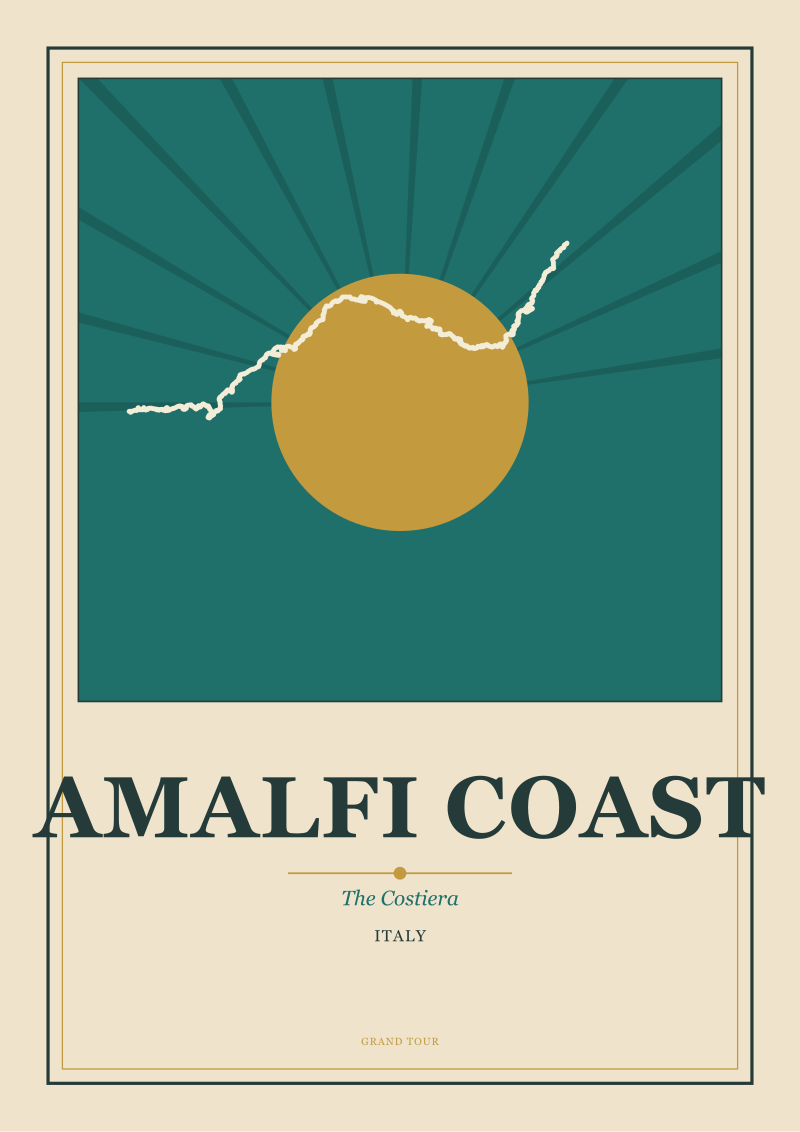
You are routed to the Mediterranean. Two candidates remain in the archive: the Amalfi Coast, whose cliff road above the sea has been drawn continuously since the early railway posters treated the Bay of Naples as the terminus of an idealized southern journey; and Barcelona, whose Mediterranean edge has always been drawn as the meeting of grid and shore. Both are coastal in the literal sense — a line of water, a line of land, and light bouncing off the seam. What separates them is the density of the arrival, and that is Question 3.
If Mountain
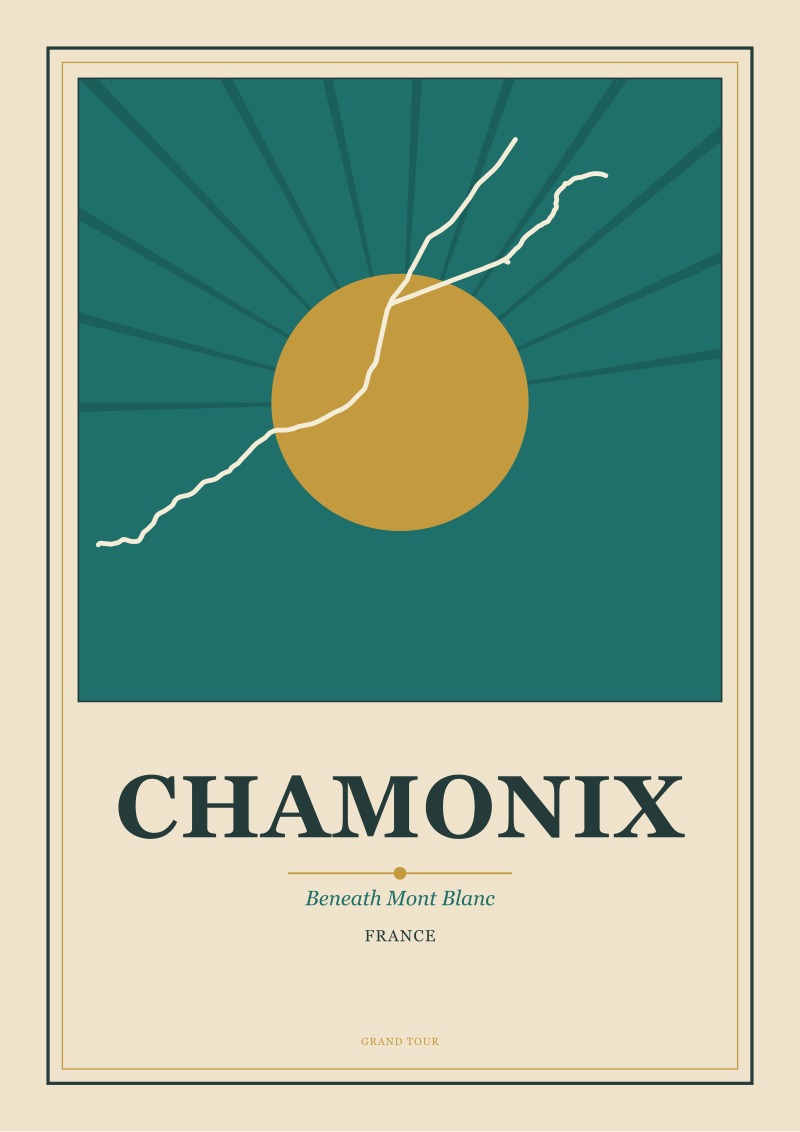
You are routed to elevation. The archive holds one alpine answer and one vertical-city answer. Chamonix, at the head of the Arve valley beneath Mont Blanc, is where the tradition of drawing mountains as objects of secular attention was largely invented in the nineteenth century. Amsterdam is the alternative reading — a city that reads vertically in profile, whose posters have historically framed it not as a plan but as an elevation, gables stacked against low Dutch sky. Choose alpine or urban vertical, and Question 2 will refine it.
Question 2: Do You Want the Poster-Era Route or the Preserved Modern Line?
The posters we work from were produced roughly between 1890 and 1950 — the era when the railway companies commissioned the images to sell the routes. Some of those routes still exist in something close to their original form. Others were rebuilt after the war, straightened, electrified, tunneled, made faster and less scenic. The question is whether you want the route as the poster artist saw it, or the version the modern network preserves.
This is not a nostalgia question. It is a geometry question. Poster-era routes tend to trace the coast or the valley floor because the rolling stock could not climb quickly, so engineers followed the land. Modern lines often cut chords across the geography — tunnels, viaducts, direct alignments — which is faster but rearranges what you see out of the window. The choice determines what enters your field of view and in what order.
If Poster-Era Route
You want the slow line, the one the railway posters actually depicted. Along the Amalfi corridor this means the road-rail combination that hugs the cliff — the modern approach still requires the sea-level line into Naples and Sorrento, then the surface route above the water, because no rebuilt alignment has replaced the geography. In the Alps it means the mountain rack and cog lines around Chamonix, sections of which have been in continuous operation since the late nineteenth century. Poster-era means the route is the reason.
If Preserved Modern Line
You want the route the modern network kept and made faster without dismantling the arrival. Barcelona is the cleanest example: the high-speed corridor down the Mediterranean flank delivers you to the city at speeds impossible in the poster era, but the final approach still crosses the coastal plain and enters a city whose grid was designed from the outset to be read at speed. Amsterdam's approach through the canal ring survives on the modern network in the same way — the last few kilometers slow to nineteenth-century pace because the canal geometry demands it. Modern line means the trip is fast until the arrival, and then it is not.
 Amsterdam
The print from this article · from €29.95
View the print →
Amsterdam
The print from this article · from €29.95
View the print →
Question 3: Is the Journey the Frame, or Is Arrival the Frame?
This is the question posterists never had to answer, because they were paid to sell one image and one image only. But for the reader routing a real trip, the framing matters. Some rail journeys in Europe are essentially moving portraits — the interest is in the passage, and where you stop is almost secondary. Others are arrivals: the trip is transit, and the frame snaps into place only when you step off the train.
Ask which one you want. The tell is usually in how you talk about the trip beforehand. If you describe the route ("along the coast," "up the valley," "through the ring"), the journey is the frame. If you describe the endpoint ("in the city," "at the harbor," "under the peak"), arrival is the frame.
If the Journey Is the Frame
You want the corridors that were drawn as continuous images — where the poster artist depicted the moving view, not the stationary destination. The Amalfi cliff route qualifies: it was drawn as a passage, the horizontal ribbon of coast unfolding under compressed perspective. The Chamonix valley approach qualifies too: the poster tradition here is the arriving view of Mont Blanc growing in scale over the last twenty kilometers. In both cases, the moment you step off the train is not the point. The point is the last hour before you do.
If Arrival Is the Frame
You want a place designed to be entered. Barcelona's Eixample grid was laid out in the 1860s explicitly to be legible on first sight, and the posters have always drawn the city as a plan seen from above or a boulevard seen along its axis — the arrival, in other words. Amsterdam works the same way: the canal ring is a rendered arrival, drawn from Centraal Station outward through the semicircles of water. The journey there is quiet; the frame turns on when you cross into the ring. If your instinct is to say "the trip is really about being there," arrival is your frame.
If You Answered Everything: The Route Table
Eight combinations, one recommendation per row. The recommendation cell states the single destination the three answers route to; the rationale is in the sections above.
| Q1 | Q2 | Q3 | Recommendation |
|---|---|---|---|
| Coast | Poster-Era | Journey | Amalfi Coast — the Costiera line as a moving portrait, drawn as a horizontal passage. |
| Coast | Poster-Era | Arrival | Amalfi Coast — the same corridor, but stop long in Positano and Amalfi town itself. |
| Coast | Modern | Journey | Barcelona — the Mediterranean high-speed corridor, coast held out the window at speed. |
| Coast | Modern | Arrival | Barcelona — arrive at Sants, walk into the Eixample grid, let the city be the frame. |
| Mountain | Poster-Era | Journey | Chamonix — the valley approach beneath Mont Blanc as the classical alpine passage. |
| Mountain | Poster-Era | Arrival | Chamonix — the same valley, but stop under the peaks and let arrival hold the image. |
| Mountain | Modern | Journey | Amsterdam — the last kilometers into the canal ring as a slow vertical portrait. |
| Mountain | Modern | Arrival | Amsterdam — Centraal Station outward, gables and water reading as an urban elevation. |
Two clarifications. First, the same destination appears more than once because Q3 refines rather than reroutes — Amalfi with journey framing and Amalfi with arrival framing are the same trip planned differently, not two different places. Second, the four destinations are not equal in kind. Chamonix is a valley terminus and reads as one place; Amsterdam is a city and reads as one place; the Amalfi Coast is a corridor of villages; Barcelona is a metropolis. The table honors the fact that a rail journey's meaning depends on what shape the destination has, not only what it is called.
We draw all four of these places as posters. If the routing above lines up with something you have been carrying in your head for a while, and you want the image before you take the trip, our archive of the four corridors above lives at see the Amsterdam print.
 Chamonix
The print from this article · from €29.95
View the print →
Chamonix
The print from this article · from €29.95
View the print →
FAQ
Why does this piece treat only four destinations when Europe has dozens of famous rail journeys?
Because the grounding for this article is a specific working archive: the four European corridors we have been drawing this season — Amalfi, Amsterdam, Barcelona, and Chamonix. Rather than list every route from memory, we routed the four we can actually speak to from the posters. The decision tree is honest about the sample. Other corridors — the Bernina, the Rhine gorge, the West Highland — deserve their own routing exercise, and we will publish it when the archive supports it.
What does "poster-era route" actually mean when a line has been electrified or rebuilt?
We use it to mean a route whose alignment on the map still traces the geography the poster artist depicted, regardless of whether the rolling stock, the electrification, or the station buildings have changed. The Amalfi corridor and the Chamonix valley both qualify because no rebuilt alignment has replaced the underlying geography — the train still follows the coast and the valley floor. If a modern tunnel has bypassed the scenic curve entirely, we do not count that stretch as poster-era.
Is Amsterdam really a "mountain" answer in Question 1?
Only in the specific poster-grammar sense of vertical composition. A city can be drawn vertically when its cornice line, spires, and gables dominate the horizon more than its street plan does. Amsterdam's poster tradition has consistently framed the canal ring as an elevation, not a plan — buildings stacked, water below, low sky above. The literal answer to "does Amsterdam sit in the mountains" is no. The compositional answer to "does Amsterdam read vertically" is yes, and that is what Question 1 is really asking.
Why isn't the Grand Tour itself on the list?
The historical Grand Tour was a curriculum of arrivals, not a rail journey — it predates the railway by about a century and moved by coach, boat, and foot through Italy and, less often, the Alps. Rail posters later adopted Grand Tour destinations as their vocabulary of desirable places, which is why Naples, the Bay, and the alpine passes recur in the archive. If you are looking for the classical Grand Tour route today, Amalfi and Chamonix are the two on our current list that sit closest to it.
How is this different from a "best of" rail journeys ranking?
A ranking would tell you which route is objectively better. This piece refuses that premise. The four destinations are not comparable on a single axis — Chamonix is a valley terminus, Amalfi is a coastal corridor, Amsterdam is a city arrival, Barcelona is a metropolitan arrival. Ranking them would require pretending they are the same kind of thing, and they are not. The decision tree instead sorts you toward the route whose shape matches the trip you actually want.
Do the recommendations account for practical considerations like duration or connections?
They do not. The routing here is compositional — it matches the reader's instinct to the poster tradition and the geography, and stops there. Practical planning is downstream of the choice. A reader who lands on Chamonix in the table still has to decide whether to enter through Geneva or through Saint-Gervais; a reader who lands on Amalfi still has to decide between the Sorrento or the Salerno approach. Those are logistics questions, not framing questions, and belong in a different piece.
What happens if my three answers pull me toward two different destinations?
That is a real outcome and worth naming. If you find yourself genuinely split between, say, Barcelona and Amsterdam, it usually means Question 1 was the wrong fork for you — the coast/mountain axis is not what your instinct is really tracking. Try re-answering Question 1 with the second reading (vertical composition, arrival scale) instead of the literal geography. If the split persists, take the trip you have not taken. The archive will still be here for the other one.
New city prints and 10% off your first order.
One email now with your code. No noise after.