Prague has never had exactly a hundred spires. The number is a nineteenth-century turn of phrase that hardened into slogan, then poster caption, then repeated fact. Hear us out. The right question is not how many spires the city holds — a rooftop and a long lens settle that in an afternoon. The right question is why the skyline reads as a hundred whether the honest tally is seventy or two hundred. The answer is geometry, geography, and the way the Vltava turns a wall of towers into a single legible horizon. It depends on who is looking, and how. Three ways of looking prove the point.
The exercise is not to arbitrate the number. It is to notice that a skyline is a made thing, edited by whoever draws it and whoever crosses the bridge at the right hour. Imagine three observers, each with a different instrument, looking at the same city on the same evening. None of them is wrong. None of them arrives at the same total. What they see, and what they cannot help seeing, is the actual subject of this piece.
Scenario 1: The Painter With One Rooftop and a Wide Lens
Let us say a painter has taken a rooftop on the Malá Strana side of the Vltava, a floor or two above the tiled ridgeline, and set up to draw the Old Town opposite. Picture the tools not as a camera but as a habit: the eye compresses distance, the wrist edits. The painter is looking across the river, roughly east, at a belt of the city perhaps a kilometre wide and half a kilometre deep. In that field of view, everything vertical folds forward onto everything else.
This is not a metaphor. It is the geometry of a wide angle on a compressed subject. Towers a hundred metres apart in plan stack visually onto the same slice of horizon. A pair of Gothic spires at the Týn church do not read as two objects but as a single dark crown with two points. A dome behind them is not "behind" — it is nested between them. The rooftop's cardinal fact is that depth collapses. A painter working in this position and drawing honestly is not counting; they are composing.
The result, and this is where the myth of a hundred spires begins to make sense, is that the count on the page is always higher than the count on the ground. The painter draws every silhouette that meaningfully punctures the skyline, and the wide lens sends more silhouettes into the frame than the plan would predict. The Vltava does the rest. A river-facing city, curved gently through its centre, gives the drawing what a straight avenue never could: a long, continuous run of façade, unbroken by cross-streets that would let the eye escape sideways. There is nowhere for the gaze to leak. Everything vertical registers.
Ask the painter how many spires Prague has, and the honest answer is: as many as the composition needs, and no fewer than the horizon supplies. It is not evasion. It is what any studio that draws cities before writing about them will tell you. The skyline is a section drawing, not a census. The hundred is a figure of speech about density, and density, in this frame, is a truthful description of what the wide lens sees.
Scenario 2: The Cartographer Who Actually Counts
Now let us say a cartographer takes the same evening and refuses the painter's game. Imagine someone with a plan of the historic core, a satellite tile at the same scale, and the patience to walk the ridges. Their instrument is different. They are not looking across; they are looking down. They are counting objects that meet a definition — masonry termination in a point, above a roofline, above a certain height — and they are willing to argue about that definition for the entire evening.
The cartographer's first honest answer is a range, not a number. Depending on where the historic core is drawn, whether they include the modern additions on the right bank, whether they count the small ancillary spires of a large church as one or as five, the tally moves. Bracket the answer at somewhere between the low tens and, if the definitions are loose, well past a hundred. The count is real. It is also not the point.
What the cartographer notices, and what the painter cannot notice from a fixed rooftop, is the distribution. The spires of Prague are not spread evenly across the plan. They cluster along two ridgelines — the castle side, the Old Town side — and stack up along the inside of the river's turn. The Vltava has done something that a grid city cannot do. It has drawn a soft, single line through the middle of the settlement, and every important vertical over centuries has arranged itself to be seen from that line. A visitor standing on a bridge sees, at once, the towers that were never meant to be seen together, because they were built in different centuries, for different institutions, without any master plan for the composite view.
This is the cartographer's real finding, and it is more interesting than a number. Prague reads as a hundred spires because the river forced its spires into a shared audience. In a city without the river, you would have to walk half a day to see them all; here, they line up for the bridge. The count on paper is honest and finite. The count on the horizon is a function of geography. Both are true. Neither invalidates the phrase.
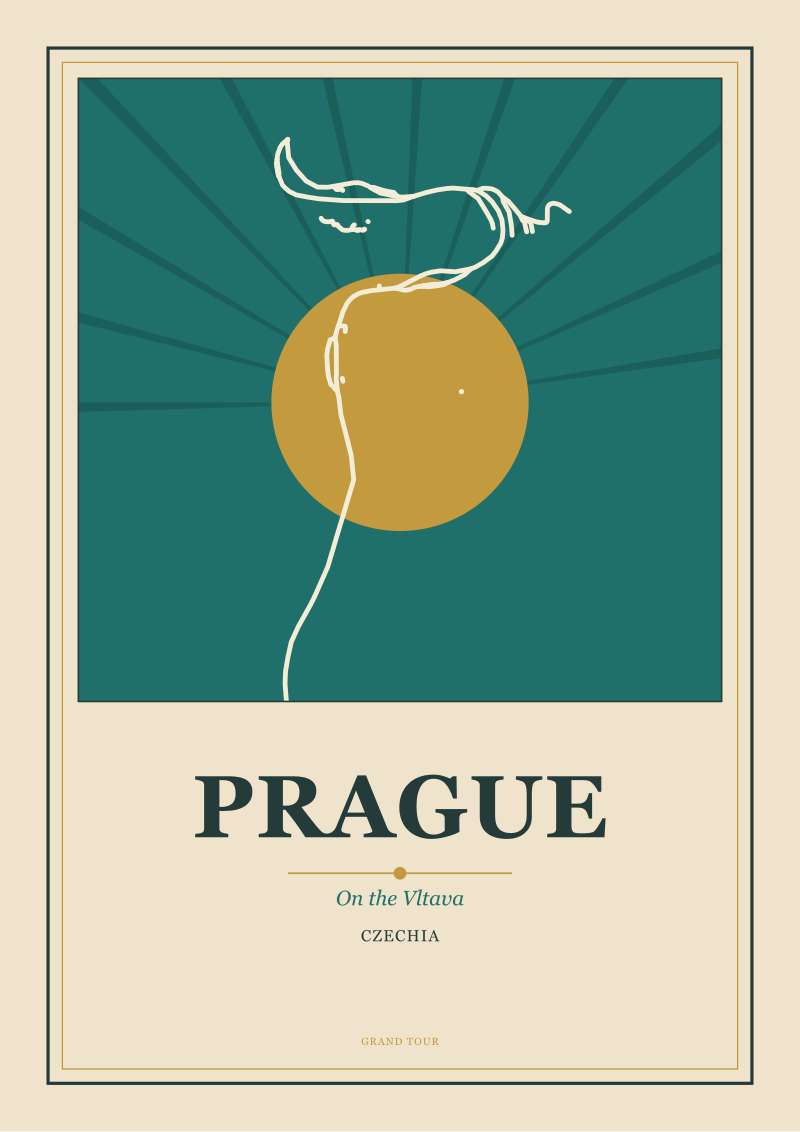 Prague
The print from this article · from €29.95
View the print →
Prague
The print from this article · from €29.95
View the print →
Scenario 3: The First-Time Visitor Crossing the Vltava at Dusk
Picture a third observer, no professional interest in the question, walking across one of the river bridges at the hour the sky goes cobalt and the streetlamps come on. Their instrument is the human eye at low light, an instrument that does not count and does not measure but does something more decisive. It reads silhouette.
At dusk, colour drains from the buildings and everything vertical becomes a black cutout against a graded sky. The tiled roofs, warm red an hour earlier, flatten into a single dark base. The spires rise out of that base as pure shape. A twin-towered Gothic front, a Baroque onion, a slim clock tower, a distant castle silhouette — each becomes an ideogram of itself. The visitor is not distinguishing centuries or orders. They are reading a pattern, and the pattern is very dense.
The eye at this hour also does something the cartographer refuses to do and the painter does deliberately. It groups. A cluster of three closely spaced points reads as one crown. A hunched dome flanked by two thin needles reads as one gesture. The visitor's mental count is neither the painter's field nor the cartographer's ledger; it is a rhythm, and the rhythm is what the phrase "a hundred spires" was always naming. Not a total. A tempo.
Then the walk carries them off the bridge, and the composition breaks. From a side street the spires disappear behind six-storey façades and reappear one at a time, framed briefly at the end of an alley. It is why the river view is the view. The Vltava is not a scenic detail. It is the only vantage from which the city's verticals resolve into a legible horizon. Every other angle in the historic core deals in fragments. The bridge deals in the whole thing at once, and the whole thing at that hour, in that light, always reads as more than it is.
What All Three Are Actually Looking At
Three observers, three instruments, three different totals, and yet all three describe the same skyline. What they share is not a number but a structural fact about the city.
Prague's historic core is compact, hilly, and organised around the inside of a river bend. Compactness stacks verticals into a shallow field of view. Hills give a second row of towers a chance to be seen above the first. The bend of the Vltava gives an observer, once, from a bridge or a river-facing rooftop, the frontal view that a straight-river city can never offer. Add to this a religious and civic history that produced towers at churches, gates, town halls, monasteries and the castle complex over roughly a millennium, without a coordinating hand, and the result is a section through architectural time that happens to be visible in one glance.
The phrase "a city of a hundred spires" is not a claim about arithmetic. It is a claim about that section — that unusual, geographically produced possibility of seeing many centuries of vertical building at once. Painters, cartographers and visitors give different numbers because they are answering different questions, but they are describing the same underlying object: a skyline that is legible as a whole because the river insists on it. Nowhere else in central Europe does the geography line up quite so decisively for a single view. That is what the slogan was pointing at, before it became a caption.
Which Scenario Is Yours
Read yourself back into the three. If you find yourself asking how many, you are the cartographer, and the honest answer is a range that depends on definitions. If you find yourself asking why the skyline hits so hard from one specific bridge and looks ordinary from a side street two blocks away, you are the painter, and the answer is composition and compressed depth. If you find yourself unable to explain the effect but certain you have seen it, you are the visitor at dusk, and what you saw was a rhythm the eye reads before the mind counts.
None of these is the right way. The city rewards all three. Our own studio's Prague poster is drawn from something close to the painter's position, edited toward what the visitor at dusk actually remembers, and checked against what the cartographer would allow — the print is at our shop for anyone who wants the composition on a wall. The point of naming the three is smaller than that. It is that the number was never the subject. The section drawing was. The Vltava, patient and unbroken, is what makes any of it possible to see.
FAQ
Where does the phrase "city of a hundred spires" actually come from?
It is a nineteenth-century turn of phrase, associated with the era in which European cities began to be described in shorthand slogans for a widening travel audience — the same period that gave Paris the "City of Light" and Venice its "Serenissima" as tourist captions. The number was never a literal count. It was a way of saying that the skyline is unusually dense with vertical church and civic architecture. The slogan hardened into a repeated fact through poster captions, guidebooks and later reprints.
So how many spires does Prague really have?
It depends entirely on how you define a spire and where you draw the boundary of the historic core. A strict definition — masonry church and civic towers ending in a point, above a set height, inside the historic centre — gives a figure in the low tens. A looser definition that counts secondary spires on large churches, minor turrets and outlying districts pushes the total well past a hundred. Both counts are honest. Neither is what the phrase was ever about.
Why does the skyline read as denser than the actual count?
Two reasons work together. First, the historic core is compact and hilly, so verticals stack visually into a shallow field of view. Second, the Vltava's curve gives you a single frontal vantage of the whole ridge from the river bridges — a view that no straight-river city can offer. The eye reads all those centuries of building at once, and the wide angle compresses depth, so towers a hundred metres apart in plan appear to sit shoulder to shoulder.
Which bridge or vantage gives the best view of the skyline?
Any of the central Vltava bridges will give you the frontal composition the phrase was describing, because the geometry of the river bend, not any single bridge, is what produces the view. Rooftop vantages on the Malá Strana side face the Old Town wall of towers; rooftops on the Old Town side face the castle ridge. Both are painter's positions in the sense used above. The point is the river-facing angle, not any specific address.
What time of day does the skyline look most like the slogan?
Dusk, and for a specific reason. As colour drains from the façades, the tiled roofs flatten into a single dark base and the spires rise out of it as pure silhouette. The eye stops distinguishing centuries and orders and starts reading a pattern of shapes. That pattern is denser than any daytime count would allow, because the mind groups closely spaced points into single crowns. Dawn produces a similar effect in reverse; midday flattens everything into detail and loses the composition.
Is this the same effect that made Prague a favourite of travel poster artists?
The underlying reason is the same: a skyline that resolves into a single legible horizon from a repeatable vantage is exactly what poster art needs. A poster is a section drawing that has to work at reading distance, and Prague hands the artist that section drawing already composed by geography. The tradition of drawing the city from the river, or from a rooftop opposite the castle, predates the golden age of travel posters and continues into it.
How does Prague's skyline compare to other European "spire cities"?
Other cities have dense clusters of towers — Bruges, Ghent, parts of Lübeck — but few offer the whole cluster in one frontal view. The Vltava's bend is the differentiator. It arranges towers built across a millennium into a shared audience at a bridge, without any master plan for the composite view. Elsewhere you often have to move through the city to see the towers in sequence. In Prague, the river gathers them.
 Paris
The print from this article · from €29.95
View the print →
Paris
The print from this article · from €29.95
View the print →
New city prints and 10% off your first order.
One email now with your code. No noise after.