Most gift guides for "the traveller in your life" are written by people who do not draw cities. We do. Before we write about a place at Grand Tour Prints, we sit with its geometry — its coastline, its grid, the river that decides where the eye goes. So this is not a ranked list of ten posters with star ratings. It is a small flowchart in prose. We are going to ask you three questions about the person you are buying for, route you through the branches, and hand you a recommendation at the end. Hear us out; the questions matter more than the answers.
Question 1: Does the Recipient Actually Love Barcelona, or Do They Love the Mediterranean?
This is the first fork because it is the one most gift-givers get wrong. The person you have in mind talks about a trip to Barcelona. They came back with a keychain of the Sagrada Família and a photograph taken from Park Güell at dusk. The obvious move is to buy them a poster with a spire on it. Resist the obvious move for a moment.
There is a difference between someone who loves *the city called Barcelona* — its grid, its buildings, its specific silhouette — and someone who loves *what Barcelona represents to them*, which is often the sea itself: a Mediterranean afternoon, a walk along a coast, the feeling of a warm coastal city that is not their own. The two people want completely different posters. One wants Barcelona rendered as itself. The other wants the coastline as an idea, and Barcelona happened to be where they met it.
Ask yourself: when they tell the story of the trip, do they describe the buildings, or do they describe the light on the water? Do they mention street names, or do they mention the smell of the harbour? A city-lover names things. A Mediterranean-lover describes weather.
If Yes — They Genuinely Love Barcelona the City
You are shopping for someone who has an opinion about Gaudí versus Cerdà. They can pronounce Passeig de Gràcia. They noticed, on their trip, that the streets do something strange at the corners — a small chamfer, an intentional cut — and they will bring it up unprompted at dinner. This person wants Barcelona as Barcelona: drawn from its own geometry, not softened into a generic Mediterranean pastel.
The right gift here is a portrait poster of the city itself, one that treats the Eixample grid as the graphic subject it actually is. Barcelona is, from above, one of the most drawable cities in Europe precisely because the nineteenth-century plan gave it a grid so clean and so specific that a poster can render it almost as a diagram. That is what this person wants on their wall: not a landmark, but the plan.
If No — They Love the Mediterranean, and Barcelona Was the Way In
This person is more common than the first, and there is no shame in it. Barcelona was the place they encountered the coast, but the coast is what stayed with them. They talk about the water. They took photographs pointing away from the city, toward the horizon. If you show them a poster of a different Mediterranean coastline — Nice, the Ligurian shore, a stretch of the Costa Brava north of the city — their eyes will do the same thing they did in Barcelona.
For this recipient, the right gift is a coastal poster in the golden-age tradition: a rail-era shoreline, a bathing scene rendered as geometry, a stretch of water reduced to two flat blues and a stripe of sand. It does not have to be Barcelona. It should not be Barcelona, actually, unless it renders the coastline specifically — the arc of Barceloneta, the harbour edge, the promontory of Montjuïc dropping into the sea. If it renders spires and terracotta, it is wrong for them, however famous the spires are.
Question 2: Do They Hang Art, or Do They Stack It?
This one is unglamorous. It is also the question the gift industry pretends does not exist. You need to know how the recipient actually treats printed things before you buy one for them.
There are people who hang what they own. Framed, wall, considered. And there are people who accumulate — a lean-to against a bookshelf, a folder of loose prints in a flat file, a stack of unframed sheets they leaf through the way other people leaf through a record collection. The two behaviours look similar from the outside and are radically different in practice. A framed A2 given to a stacker will sit in its original packaging for eighteen months. An unframed archival print given to a hanger will feel, to them, like an unfinished gift.
The tell is usually visible if you have been to their home. Are the walls busy or empty? Are there frames leaning on the floor waiting to be hung, or are there prints tucked into a portfolio? Do they own a frame collection or a print collection? These are opposite hobbies wearing the same clothes.
If They Hang — Buy the Poster With the Frame in Mind
Give the hanger a print at the size they will actually mount. The mistake here is going too small. A2 (about 42 × 59 cm) reads as a poster on a wall; A3 reads as an afterthought. If you know the room the poster will live in, or you can ask a co-conspirator who does, choose the size that fits the wall's proportion, not the size that fits the box you are shipping.
The other move for hangers: consider giving the print already framed, in a plain oak or black wood, thin profile. Golden-age travel posters were designed to be seen at a distance with generous margin. A frame with a proper mat gives the composition the room it was drawn for.
If They Stack — Buy the Print, Skip the Frame
The stacker's pleasure is in the object itself: the paper stock, the weight, the fact that the ink actually sits on the surface rather than being sprayed onto it. Give them an archival print on cotton or a mould-made paper with visible tooth, unframed, in a rigid tube. Do not force them into your framing decision. They will make their own, or they will leave it in the tube and pull it out to show friends, and both of those outcomes are correct for who they are.
A small extra move for stackers: a print in a slightly less obvious size (say B2, or a proportion that leans European rather than American) signals that the giver understood the object as an object, not as decor.
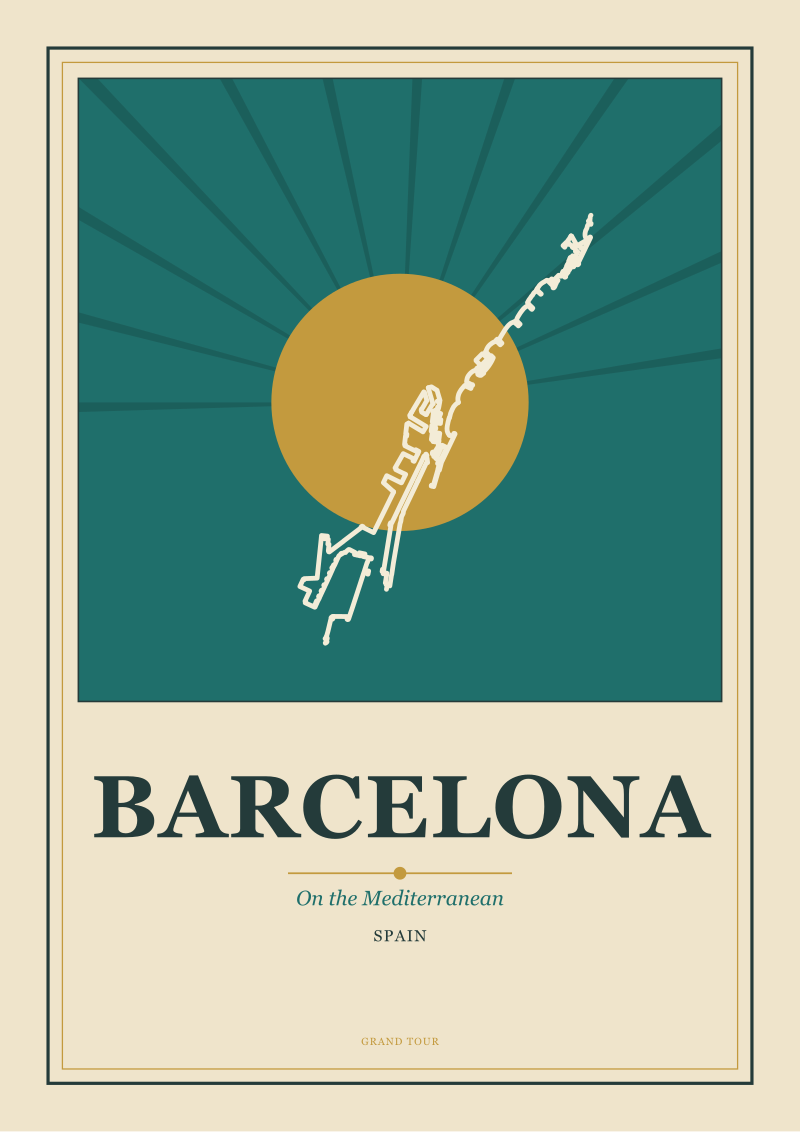 Barcelona
The print from this article · from €29.95
View the print →
Barcelona
The print from this article · from €29.95
View the print →
Question 3: Are They a Coastline Person, a Grid Person, or a Skyline Person?
This is where the guide branches wider, because it is where the recipient's actual visual taste lives. Some people are drawn to coastlines: soft curves, water meeting land, the edge condition. Some are drawn to grids: cities that read as pattern, plans you can trace with a finger, the intelligence of a nineteenth-century planner made visible from above. Some are drawn to skylines: the vertical incident, the count of spires, the silhouette against a colour field.
You can usually work this out by looking at their phone's camera roll from any trip, if they will let you scroll. Coastline people frame horizons. Grid people frame streets from the middle, looking down. Skyline people frame from a distance, always trying to fit the whole silhouette into one image.
Coastline Person
They want the poster of a shore. Barcelona works — its coastline is one of the most confidently drawn edges in the western Mediterranean, and its geometry is available from public sources with real accuracy. So does Nice, so does a stretch of the Ligurian coast, so does the Adriatic bend near Split. What matters is that the poster treats the coast as the *subject*, not as background scenery behind a landmark.
Grid Person
Give them Barcelona from above, or Manhattan, or the octagonal blocks of Buenos Aires. The Eixample is one of the great graphic-design subjects of urban planning: a grid of chamfered squares that turns the city, at cartographic scale, into a piece of pattern-making. A poster that renders that grid faithfully is a piece of both geography and design history.
Skyline Person
Prague, Florence, Venice. Cities whose profile against the sky is countable — spires, domes, campaniles arranged in a specific rhythm. Barcelona is less naturally a skyline city than a plan city; the Sagrada Família dominates, but the surrounding skyline is comparatively low. If the recipient is a skyline person and they love Barcelona, that is a signal that they love one specific spire and want it isolated, not the profile of the city as a whole.
If You Answered Everything: The Recommendation Table
Route yourself through the three questions and match the combination to the row. Each recommendation is meant as a starting point, not a final choice; the shop has variants of each.
| Q1 (City or Mediterranean?) | Q2 (Hang or Stack?) | Q3 (Coast / Grid / Skyline?) | Recommendation |
|---|---|---|---|
| City | Hang | Coast | Framed A2 Barcelona coastline print, focusing on the Barceloneta arc and harbour edge. |
| City | Hang | Grid | Framed A2 Eixample-grid poster of Barcelona, rendered from cadastral geometry. |
| City | Hang | Skyline | Framed A2 Barcelona silhouette with the Sagrada Família as the vertical anchor. |
| City | Stack | Coast | Unframed archival Barcelona coastline print on cotton paper, B2 or larger. |
| City | Stack | Grid | Unframed Eixample-grid print on mould-made paper, shipped in a rigid tube. |
| Mediterranean | Hang | Coast | Framed coastal poster from a non-Barcelona shore they have visited or want to visit. |
| Mediterranean | Stack | Coast | Unframed coastal print, generous margin, from the /shop/ Mediterranean set. |
| Mediterranean | Either | Grid or Skyline | Reconsider — the recipient probably wants a coastline print, not a city portrait. |
The last row is the one we would ask you to sit with. If someone loves the Mediterranean as an idea rather than Barcelona as a place, a grid poster or a skyline poster will land as clever-but-wrong. Trust the coast in that case. Our own set of coastline prints, drawn from public geographic sources, is at /shop/ and organised by shoreline rather than by city.
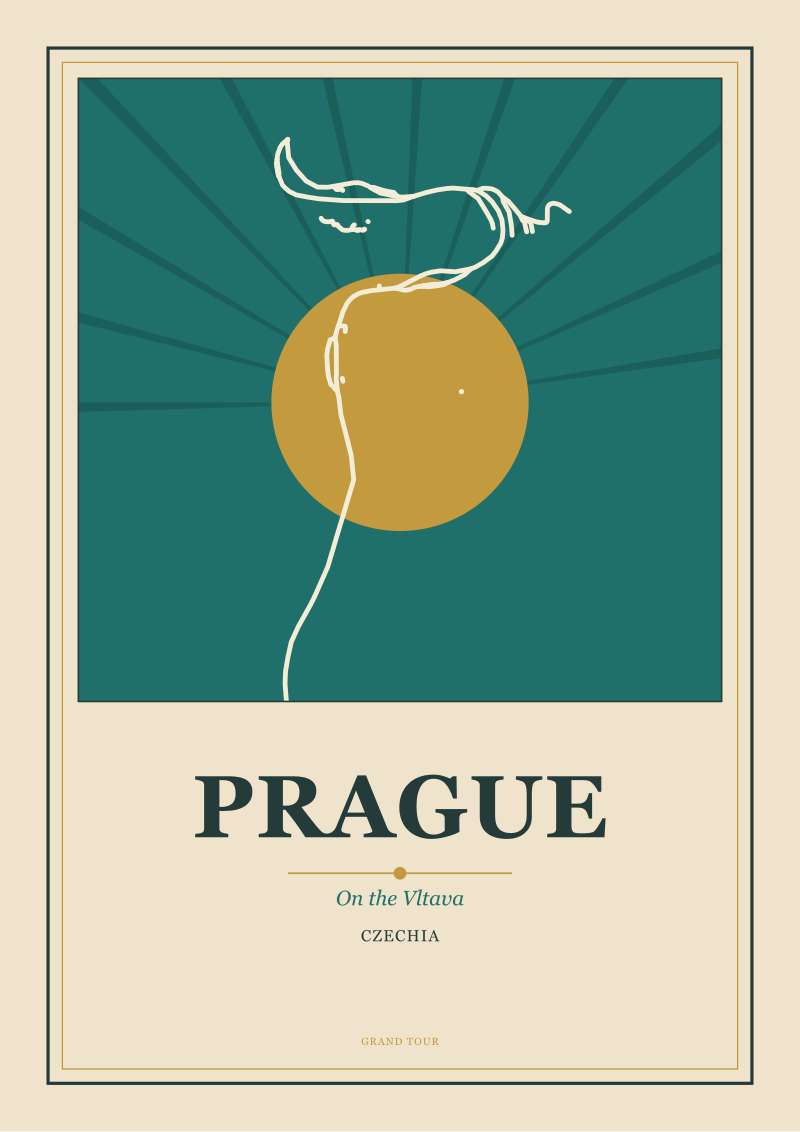 Prague
The print from this article · from €29.95
View the print →
Prague
The print from this article · from €29.95
View the print →
What This Guide Does Not Do
We should be honest about scope.
This guide does not address the wall it is going on. We can help you choose a print, but we cannot see the room. Light matters. A print with a lot of paper white will read differently in a north-facing room than in a south-facing one, and no gift guide written at a desk in another country can adjudicate that. If it matters, ask the recipient's partner or flatmate for a photograph of the wall first.
It does not address framing beyond the general suggestion to prefer thin profiles in oak or black wood. Framing is its own discipline, and a bad frame can undo a good print faster than most gift-givers realise. If you are new to it, a local framer will do a better job than any mail-order option we could recommend from here.
It does not address budget in explicit tiers, because we do not want to pretend that a more expensive print is a better gift. It is not. A small, correctly-chosen print for the right person beats a large, generically-chosen print every time. The Question 1 through Question 3 fork above matters more than the price.
And it does not cover destinations we have not drawn. We can speak to Barcelona and the Mediterranean coastline with confidence because we have sat with their geometry — the coast is anchored in OpenStreetMap-derived geographic sources, the grid is anchored in the historic Cerdà plan. For cities we have not yet portrayed, we would rather stay quiet than recommend something we have not drawn ourselves.
FAQ
How do I know what size poster to buy if I have not seen the recipient's home?
The safest default is A2, roughly 42 by 59 centimetres, which reads as a proper poster on almost any wall without dominating it. If you know the room is small — a hallway, a study nook — A3 works but feels closer to a print than to a poster. If you know the room is generous and the wall is bare, consider B2 or larger, which gives the composition breathing room appropriate to golden-age poster design.
Is a framed print a better gift than an unframed one?
Not automatically. It depends on whether the recipient hangs what they own or collects unframed prints as objects. Framing forces your aesthetic choice on them, which a stacker will politely tolerate and quietly resent. If you are not sure which they are, an unframed archival print in a rigid tube is the more generous default — it lets them make the framing decision themselves, and the object arrives intact regardless.
Should a Barcelona lover always receive a Barcelona poster?
Not necessarily. If they love the city specifically — its grid, its buildings, its plan — then yes, a Barcelona poster is the right answer. If they love what Barcelona represented to them, which is often the Mediterranean coast rather than the city itself, a coastal print from a different shoreline may land more truly than another spire silhouette. Question 1 in the guide above is designed to surface this distinction before you buy.
Are travel posters in the golden-age tradition dated as a gift in 2026?
No, and if anything the opposite. The genre is now understood as a coherent design tradition rather than as period kitsch, and contemporary work that draws cities from their real geography sits comfortably in the same conversation as the mid-century originals. What is dated is the generic Eiffel-Tower-in-pastel variety mass-produced for tourist stalls; what is not dated is a poster that renders a specific place from its actual geometry.
What is the difference between an archival print and a regular poster print?
Archival prints use pigment-based inks on cotton or mould-made paper rated for decades of colour stability under normal indoor light. Regular poster prints typically use dye-based inks on lighter, coated stock that will shift or fade noticeably within a few years, especially near a window. For a gift meant to live on someone's wall for a long time, the archival version is worth the difference in price.
Can I give the same poster to two people who both visited Barcelona together?
You can, but it is often the less considered choice. A shared trip does not mean shared taste. One traveller may have loved the grid from above; the other may have loved the coast at sunset. Route each of them through the three questions separately — the answers may diverge more than you expect, and giving each of them the poster that matches their own eye is a warmer gift than giving both of them the same souvenir.
Where can I actually see the coastline and grid prints referenced in this guide?
Grand Tour Prints keeps its full set at /shop/, organised by geographic subject rather than by city name — coastlines under one heading, city grids and plans under another, skylines and silhouettes under a third. That structure exists precisely so that a gift-giver working through the questions above can route directly to the section that matches the recipient, rather than scrolling past prints that were never going to fit.
New city prints and 10% off your first order.
One email now with your code. No noise after.